Medical gas pipeline systems in hospital design
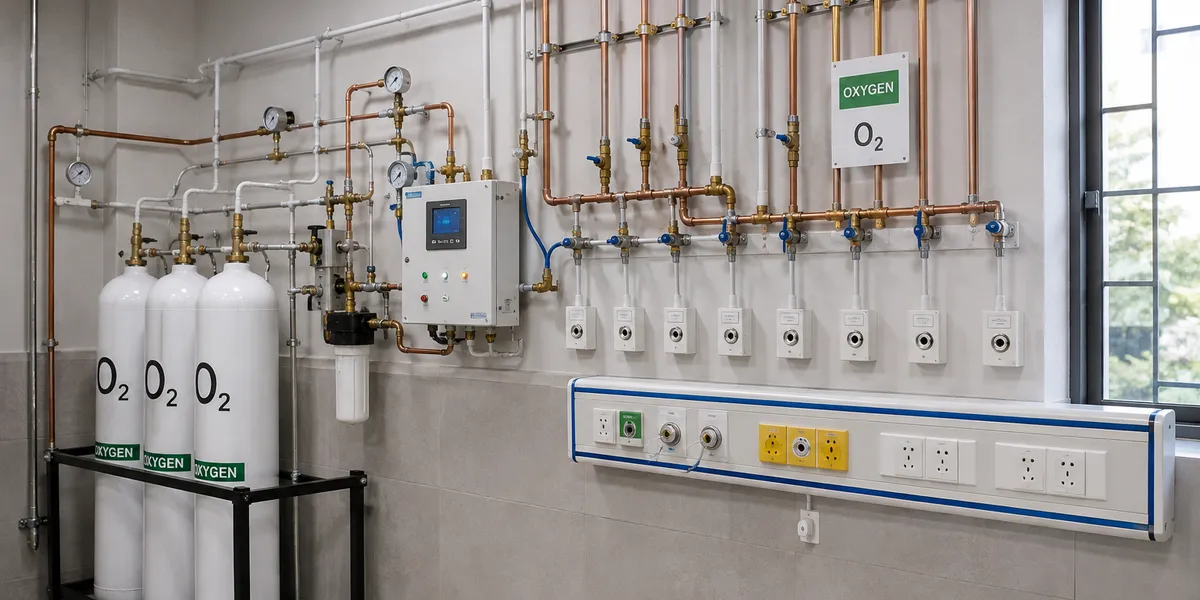
A medical gas pipeline system (MGPS) is the fixed network of the source plant, solid-drawn copper pipework, isolating valves, alarm panels, and gas-specific wall outlets that carries oxygen, nitrous oxide, medical air, surgical air, and medical vacuum from the central plant to the bedside. Rather than wheeling cylinders to every bedspace, the building itself distributes each service to terminal units in wards, operating theatres, recovery, critical care and A&E. For a project team planning a new hospital wing or refurbishing an existing one, the MGPS is estates infrastructure that must be designed, installed, tested and formally validated before it carries gas to a patient.
The governing framework in the UK is Health Technical Memorandum HTM 02-01, used alongside the international pipeline standard ISO 7396-1. This article is the umbrella overview of how the whole system fits together; the individual source plants for oxygen, medical air, vacuum and nitrous oxide each have their own dedicated guide.
This overview is compiled from HTM 02-01, ISO 7396-1 and MHRA medical device guidance as they apply to UK pipeline installations, and is written for estates, procurement and biomedical teams rather than for patients.
The gases and services a pipeline distributes
An acute hospital pipeline usually carries several separate services, each with its own source, nominal pressure and colour identity. Oxygen and nitrous oxide are both distributed at a nominal 400 kPa (4 bar). Medical air is supplied at 400 kPa for breathing and driving ventilators, while surgical air (tool air) runs at 700 kPa (7 bar) to power pneumatic instruments in theatre. Medical vacuum is not a supplied gas at all but a distributed negative pressure used for suction. Larger sites may also use carbon dioxide piping, Entonox (a 50/50 oxygen and nitrous oxide mix), and anaesthetic gas scavenging (AGSS) to remove waste anaesthetic from theatres.
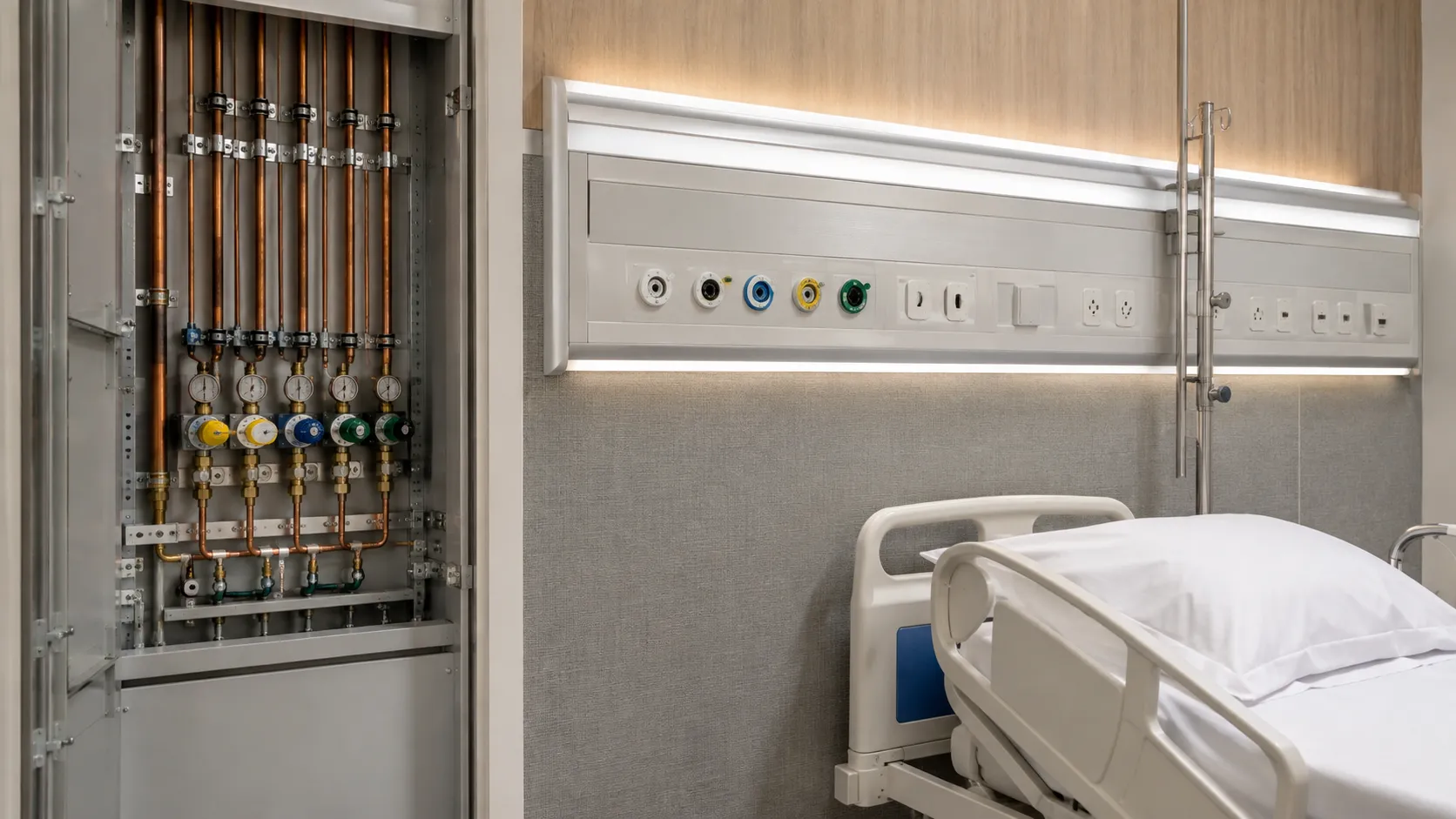
Each service is colour-identified for safety — white for oxygen, French blue for nitrous oxide, black and white for medical air, and yellow for vacuum — and every terminal unit is gas-specific and mechanically non-interchangeable, so a probe for one gas cannot connect to another.
From source plant to terminal unit
The pipeline runs in three broad stages. First, the source: a liquid oxygen vessel or concentrator plant, a compressor set for air, a vacuum pump plant, and cylinder manifolds for nitrous oxide, each sized with duty and standby capacity. Second, the distribution: copper pipework degreased for oxygen service, rising through the building with pressure regulation, area valve service units (AVSUs) that isolate a department in an emergency, and line-pressure and plant alarms monitored around the clock. Third, the point of use: the terminal unit at the bedhead, pendant or theatre wall, where staff connect flowmeters, ventilators or suction with a gas-specific probe.
AVSUs matter in design because they allow a ward or theatre to be isolated for maintenance or in the event of a fire without shutting down the whole hospital. Alarm panels — plant, emergency and clinical — warn estates and clinical staff of pressure faults or a source running low.
HTM 02-01 and ISO 7396-1: the design framework
HTM 02-01 is published in parts covering design, installation, validation and verification, and the operational management of a system in service. It sets expectations for pipeline sizing, materials, testing for cross-connection, purity, and particulates, and for labelling and identification that prevent a gas from being wrongly connected. ISO 7396-1 is the parallel international standard for compressed medical gas and vacuum pipeline systems, covering source supply, monitoring and alarm requirements. A UK design is expected to satisfy both.
Because a completed MGPS is a medical device, it also falls under UK medical device regulation. The system, its components and its installer's conformity are matters the MHRA oversees, and finished systems carry UKCA or CE marking with the appropriate conformity assessment.
The roles that keep a system safe
HTM 02-01 defines a chain of named, competent people rather than leaving safety to chance. The Authorised Person (AP) manages system operations and issues permits to work; the Competent Person (CP) carries out installation and maintenance under that permit; and clinical governance is held by a Designated Medical or Nursing Officer, who authorises work affecting patient areas. A Responsible Person at board level and a Quality Controller for purity testing complete the structure. For a buyer or estates lead, confirming that your maintenance contractor supplies genuinely certificated APs and CPs is as important as the hardware itself.
Design principles for a new build or refurbishment
Good MGPS design starts from clinical demand — how many oxygen and vacuum outlets each bedspace and theatre needs, and the simultaneous-use assumptions (diversity factors) that size the plant and pipework. Resilience is built in through duplex or triplex source plant with automatic changeover, so a single compressor or pump failure does not interrupt supply. Emergency and reserve manifolds provide backup, and the pipeline is zoned with AVSUs so departments can be isolated independently. Alarm coverage, clear labelling, and space for future expansion are all decided at the design stage, because retrofitting them into a live hospital is expensive and disruptive.
Planning an MGPS installation: points to confirm
-
Clinical demand and outlet schedule agreed per department, with diversity factors documented for plant sizing.
-
Source plant specified with duty/standby (duplex) redundancy and automatic changeover for every service.
-
Compliance with HTM 02-01 and ISO 7396-1 written into the specification and the validation plan.
-
AVSUs, line-pressure indicators and a full alarm scheme (plant, emergency, clinical) included and located.
-
Terminal units confirmed gas-specific, colour-coded, and compliant with the correct UK connector standard.
-
UKCA/CE conformity and installer certification (AP/CP) evidenced before handover.
-
Validation and verification programme, including cross-connection and purity testing, scheduled before first clinical use.
-
A named maintenance provider and spares-and-response arrangement confirmed for the life of the system.
Terminal units, connectors and gas identification
The terminal unit is where the pipeline meets clinical equipment, and its design is a key factor in ensuring system safety. Each unit is gas-specific and keyed so that only the matching probe engages: UK terminal units commonly use the Schrader-type quick-connect probe defined in BS 5682. In contrast, flexible assemblies and anaesthetic connections use non-interchangeable screw threads (NIST). Colour, shape and mechanical keying work together, so an oxygen flowmeter cannot be pushed into a nitrous oxide outlet. For a buyer, confirming the connector standard and the availability of replacement probes and blocks matters as much as the plant itself, because terminal units are handled constantly and wear out over time.
Identification runs the full length of the system. Pipework is labelled with gas name, colour and flow direction; AVSUs and alarm panels are labelled by zone; and every outlet carries its gas identity. This labelling discipline is not cosmetic — it is the last line of defence against a maintenance error, and it is checked at validation. Modern systems increasingly link plant and pressure alarms to the estates building-management system and a central monitoring station, so faults are logged rather than relying on a local panel being noticed. When specifying an upgrade, ask how the alarm and monitoring scheme integrates with existing estates systems and whether it meets the alarm categories HTM 02-01 expects.
Validation, handover and life in service
An MGPS is not usable until it has been validated and verified — a documented sequence of pressure tests, cross-connection checks, and gas identity tests signed off before the system is filled and handed to the clinical team. In service, the AP manages planned maintenance, alarm testing and periodic revalidation. Servicing is a recurring cost that a business case must capture alongside liquid oxygen or cylinder supply, electricity for compressors and pumps, filter and desiccant replacement, and eventual plant renewal. Comparing maintenance providers on certification, response times, and spare parts availability protects both patient safety and the budget over the life of a system that may run for decades.
Choosing well for a hospital project
The MGPS is one of the few building services where a design fault can directly threaten patient safety, so it rewards careful specification and honest supplier comparison. MediGear is a UK medical equipment distributor that helps estates and procurement teams compare verified suppliers of pipeline components, terminal units, and source plant against the standards their project must meet. If you are scoping a new installation or an upgrade, our buyer resources and supplier network are a practical starting point, and you can contact the team to discuss a specification. For regulatory details, the MHRA and gov.uk provide the primary UK guidance.
Disclaimer
This article is for informational purposes only. It is published by MediGear (medigear.uk) for general information and procurement guidance. It is not clinical, diagnostic, treatment, technical, engineering, legal or regulatory advice, nor a product endorsement, guarantee or substitute for professional assessment. MediGear does not provide medical consultations. Buyers should consult their clinical, biomedical, estates and regulatory contacts, and the manufacturer's documentation, and independently verify all specifications, certifications, compatibility and suitability before purchase. Specifications, certifications and availability are correct at the time of publication and may change without notice. MediGear is a medical-equipment distributor and does not sell medicines or pharmaceutical products.