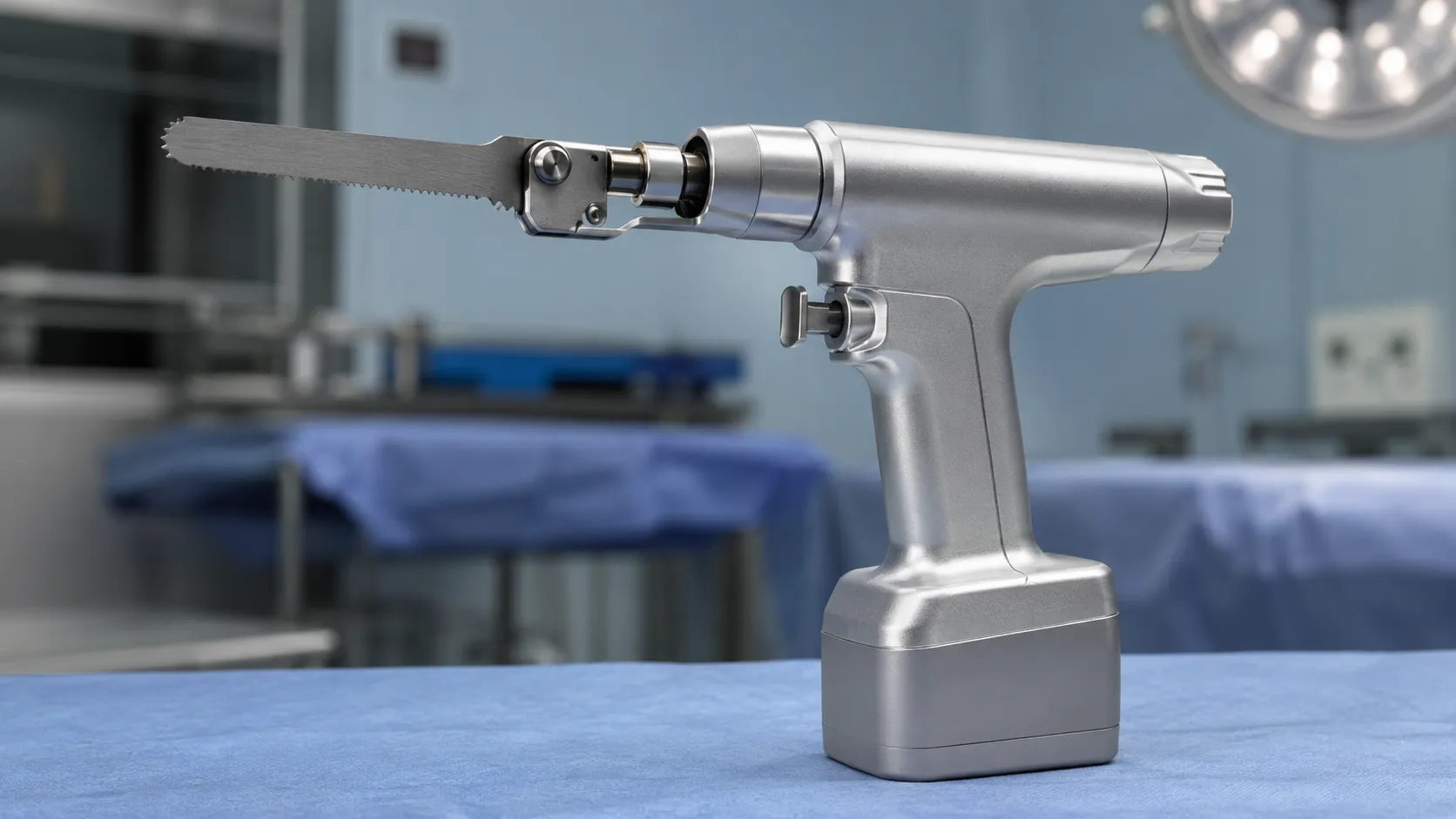
A surgical power saw is a powered instrument that drives a toothed blade to cut bone cleanly and accurately during orthopaedic and trauma surgery. Unlike a drill, which makes holes, a saw makes precise linear or planar cuts: resecting the ends of a femur and tibia to seat a knee implant, performing an osteotomy to realign bone, harvesting a bone graft, or cutting through the sternum or a long bone in trauma. The blade does the work, so blade choice governs the quality of the cut as much as the tool itself.
For a theatre or biomedical procurement lead, saws are a capital handpiece plus an ongoing supply of blades. Hence, the decision concerns the drive system, the blade range, and the recurring consumable and service costs. Hence, the drive system, the blade range, and the recurring consumable and servicing costs. This guide specifically focuses on saw spot drills.
The three saw actions and where each is used
Oscillating (sagittal) saws
The most common orthopaedic saw. The blade oscillates rapidly through a small arc in the plane of the blade, making straight planar cuts. This is the workhorse for total knee and hip arthroplasty resections and many osteotomies, because it gives flat, controlled cuts, often guided by a cutting jig. The oscillating action limits soft-tissue injury because the blade grabs bone rather than winding up soft tissue.
Reciprocating saws
The blade moves back and forth along its length, like a powered hacksaw. Reciprocating saws suit trauma work, amputation and cutting where a plunge or deeper cut is needed, and where the blade must reach into a confined space. They remove bone quickly but with less olat-plane precision than a sagittal saw.
Oscillating-tip and specialist saws
Small oscillating-tip saws and specialist designs handle fine work, hand and foot surgery, and cuts near delicate structures, while sternal saws are configured for opening the chest. Choosing the action to the procedure is the first specification decision.
Blades: the consumable that defines the cut
Blade selection matters more than most buyers expect. Key blade variables include:
-
Kerf — the width of material the blade removes. A narrower kerf removes less bone and generates less heat, but a blade that is too thin can deflect; matching kerf to the cut preserves bone and accuracy.
-
Tooth pitch and set — coarser teeth cut dense cortical bone faster, finer teeth give smoother cuts in cancellous bone; the set of the teeth affects clearance and heat.
-
Blade thickness and length — thicker blades resist deflection for accurate planar cuts, and length and shape must match the anatomy and any cutting jig.
-
Fitment — blades must match the specific handpiece hub, so a blade range is tied to the saw platform you choose.
Blades are single-use for good reason: a sharp blade cuts fast at lower temperature, while a blunt or reused blade generates heat that risks thermal necrosis of the bone and cuts poorly. Heat control through sharp blades, sensible speed, and irrigation is a genuine clinical concern in bone cutting.
Battery, pneumatic and mains drive compared.
The drive system shapes autonomy, power and reprocessing. Battery-powered saws dominate modern arthroplasty and trauma because they are cordless, powerful, and free of air lines, at the cost of battery management, charging, tracking, and eventual cell replacement, and a sterile transfer routine. Pneumatic saws run on medical compressed air or nitrogen, delivering high, consistent power with a lightweight handpiece. Still, they need a gas line and a regulator, and need that supply in the theatre. Mains-electric saws are less common in major orthopaedics now and are in other settings. Many plants are modular, so a single console or battery system can run saws, drills, aerators, and reamers, which simplifies.
Key specifications a buyer must check
Confirm the saw action needed, sagittal, reciprocating or both, and whether one modular platform covers your saws, drills and reamers. Check the blade range and fitment: the platform must offer the blade thicknesses, kerfs, tooth patterns and shapes your surgeons use, and those blades must be readily available. Review oscillation frequency or stroke rate and power, and the weight and balance in the hand, which affect fatigue and control on long lists. Assess the sterilisation method and cycle life of the handpiece and, for battery systems, the sterile-transfer routine and battery lifespan. For pneumatic saws, confirm your gas supply, pressure and hose compatibility. Finally, check servicing, warranty and spares.
Sterilisation and reprocessing
Bone cutting is a reprocessing-heavy activity. Blades are single-use and must not be reused. The handpiece is reusable and must be decontaminated and steam-sterilised between patients per the manufacturer's validated instructions, and battery-powered s. Battery-powered transfer step: a charged battery is loaded into a sterilised handpiece without compromising sterility. Buyers should confirm the handpiece's stated sterilisation cycles and lifespan, because a saw that tolerates many cycles lasts longer in a high-throughput theatre, and check that the reprocessing routine fits your sterile-services department. Pneumatic hoses and couplings also have reprocessing requirements. Follow the instructions for use exactly and never reprocess single-use blades.
Use across settings
Power saws feature use across elective orthopaedics, trauma and specialist work. A high-volume arthroplasty centre invests in battery sagittal saws with a full blade range and a range of blades for knee and hip resections. A trauma unit needs reciprocating capability for amputation and complex fracture work as well as sagittal saws. Hand, foot and paediatric orthopaedic services use smaller, finer saws and blades. Cardiac theatres use sternal saws. Veterinary orthopaedics uses the same tools scaled to the animal. Matching the saw action, platform and blade range to the caseload avoids both under-equipping a trauma service and over-buying for occasional cuts.
Consumables and total cost of ownership
The blade is the dominant recurring cost, so model annual blade use by procedure and blade type across your lists. A handpiece and batteries are capital items with finite lifespans, so budget for battery replacement and eventual handpiece renewal alongside blade sharpening, calibration where applicable, and pneumatic supply, all of which add to the total. Standardising on one modular platform for saws, drills and reamers simplifies stock, training and servicing and keeps blade and battery ranges manageable. Reliable blade supply and clear lead times matter as much as unit price, because a missing blade size can stall a list. Our team can help you scope a saw platform and blade contract — register as a buyer or contact us to review options.
Regulation and safe use
Surgical power saws are active medical devices and must carry a valid UKCA or CE marking with instructions for use, and their design and performance draw on the IEC 60601 standard, which sets out electrical safety requirements for medical devices in the UK, with wider guidance on GOV.UK. Bone cutting produces waste and requires HSE and safety precautions. Procurement's role is to ensure that the platform and servicing meet these requirements and that maintenance and validated reprocessing are in place; safe cutting itself depends on trained surgeons, sharp blades, and appropriate irrigation.
Procurement checklist
-
Confirm the saw action needed — sagittal-rotating or both — and modular platform coverage.
-
Check the blade range: thickness, kerf, tooth pattern, shape and handpiece fitment.
-
Pin down blade supply, pricing and lead times, since blades are the dominant recurring spend on any saw platform.
-
Compare battery, pneumatic and mains drive against your theatre setup and case mix.
-
For pneumatic saws, confirm gas supply, pressure and hose compatibility.
-
Assess handpiece sterilisation cycles, battery sterile-transfer and lifespan.
-
Confirm UKCA or CE marking, IEC 60601 electrical safety, servicing, warranty and spares.
Conclusion
Surgical power saws make the precise bone cuts that arthroplasty, osteotomy and trauma surgery depend on, and the blade defines the cut as much as the saw. Buying well means matching the saw action to your procedures, choosing a platform with the right blade range and fitment, comparing battery against pneumatic, and getting realistic pricing, batteries and reprocessing. Confirm the regulatory and electrical-safety documentation and the servicing arrangements, then standardise where you can. MediGear can supply orthopaedic power saws and blades matched to your theatres so your bone cutting is accurate, safe and cost-effective.
Disclaimer
This article is for informational purposes only. It is published by MediGear (medigear.uk) for general information and procurement guidance, and is not clinical. It is not clinical, treatment, technical, engineering, legal or regulatory advice, nor a product endorsement, guarantee or substitute for professional assessment. MediGear does not provide medical consultations. Buyers should consult their clinical, biomedical, estates and regulatory contacts, and the manufacturer's documentation, and independently verify all specifications, certifications, compatibility and suitability before purchase. Specifications, certifications and availability are correct at the time of publication and may change without notice. MediGear is a medical-equipment distributor and does not sell medicines or pharmaceutical products.