
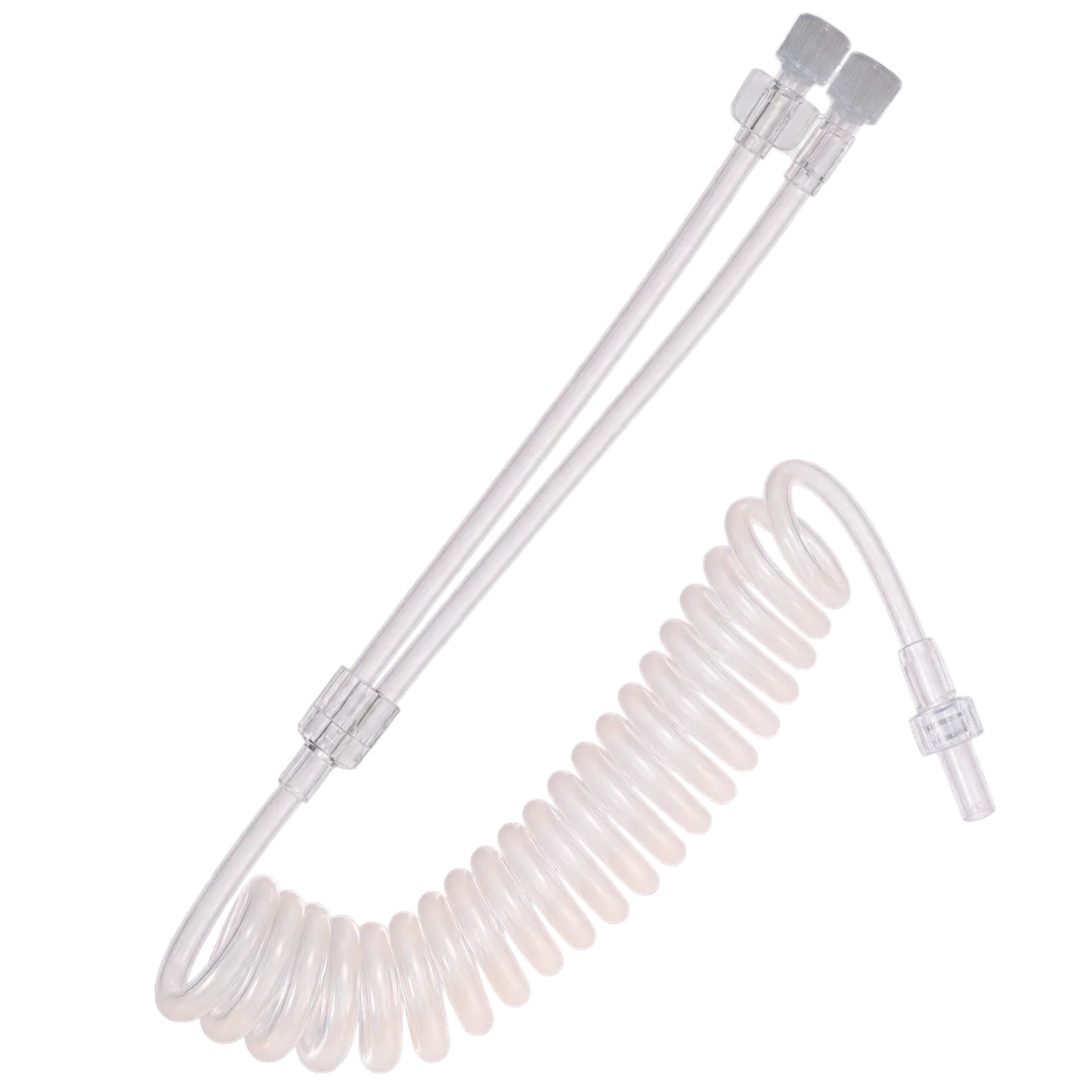

Any line running from a pump or syringe to a patient has to be long enough for the worst case. The patient may be moved, the trolley repositioned, the equipment shifted during imaging. Sizing the tubing for that leaves it too long the rest of the time, and the surplus has to go somewhere.
Loose tubing is a nuisance and occasionally more than that. It loops across bedding where it can be lain on, it hangs toward the floor where it collects contamination, and it presents something to catch on a rail or a moving trolley. A line pulled taut transmits that force to whatever it is connected to, which at the patient end is a cannula or a catheter.
Coiled tubing removes the surplus without anyone having to attend to it. The helix extends under tension and returns when released, so the line is only as long as it currently needs to be. Beyond that convenience, the specification questions are the usual ones for a fluid path. Pressure rating determines whether the line can be used with a powered injector or only by hand, and 500 psi against 350 psi separates the two families here. Bore governs flow rate and priming volume, with the wider PVC lines passing more and the finer polyurethane lines holding less. Check valves matter wherever more than one source shares a route to the patient. Material declarations matter for anything in prolonged contact.
Line selection is made against the injector or pump in use as much as the patient. Medigear.uk supplies the instructions for use with every order.