
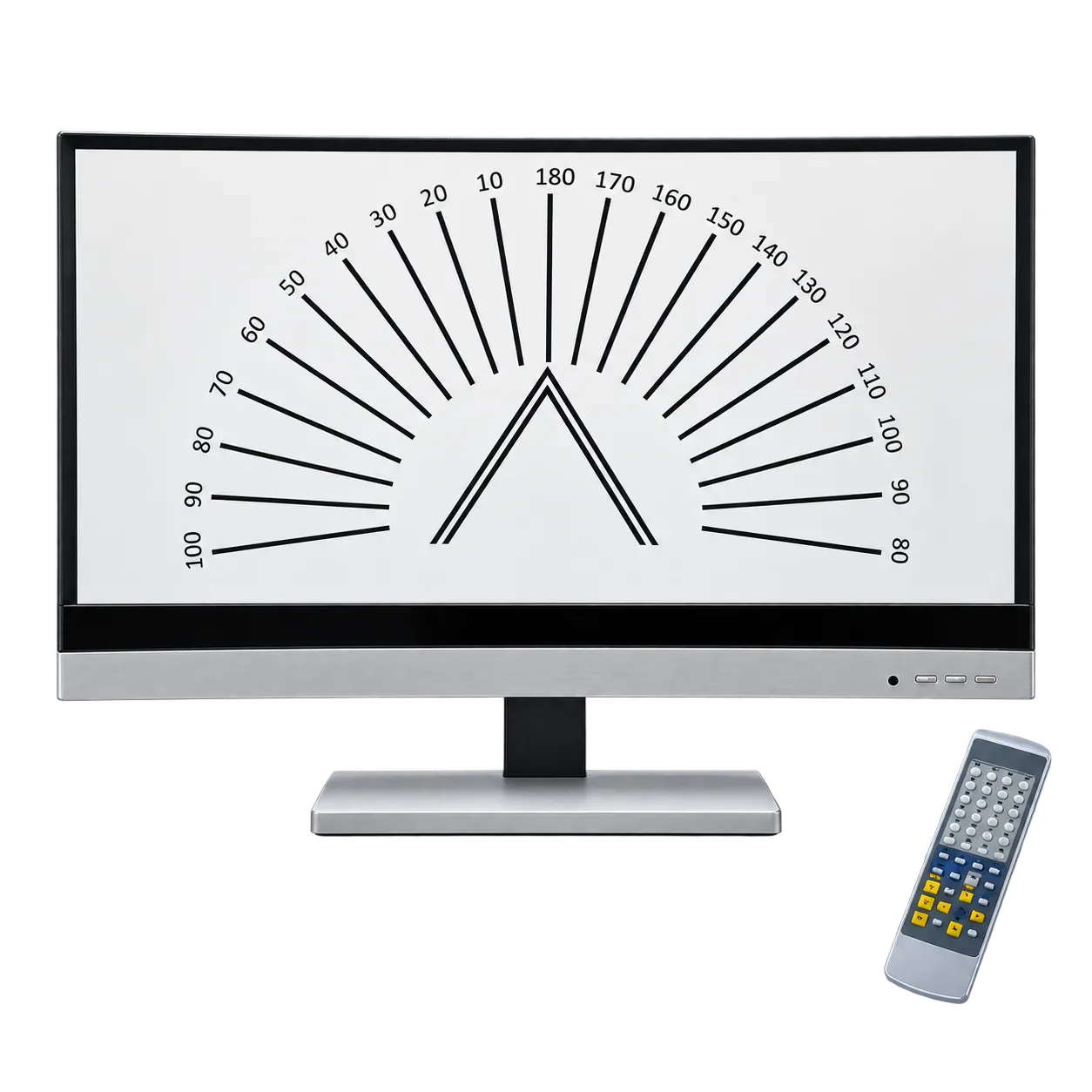
Low vision assessment is where the larger panel earns its cost. A practice measuring acuities of 6/60 and below works entirely at the top of the chart, where optotypes are largest and where a panel with insufficient area must either crop the target or force a shorter working distance. Patients under monitoring for macular disease, advanced glaucoma and diabetic maculopathy fall into this group, as do those being assessed against certification thresholds, and for all of them a measured value rendered at correct size is the point of the examination.
Long consulting rooms benefit equally. Practices able to work at six or seven metres directly, rather than through a mirror, gain a simpler optical arrangement and a more natural patient experience — but only if the display can render the largest targets at that distance. The 2.0 to 7.0 metre span with accurate optotype scaling makes the full range usable rather than nominal.
Repeat and monitored patients are served by randomised sequencing. Anyone attending frequently sees the same chart repeatedly, and a familiar sequence quietly inflates recorded acuity without any signal the clinician can detect. Randomising each presentation removes the mechanism, which matters most in the pathways where a change in acuity is the outcome being tracked.
Paediatric and communication-limited patients use the alternative chart versions — tumbling E, Landolt C and child optotypes — presented on the same panel at the same distance as the letter charts, so results across patient groups remain comparable. Two commissioning points deserve attention: the working distance must be measured and set accurately, since optotype scaling depends entirely on it, and the panel must be sited clear of direct sunlight and strong reflected light, which degrade a monitor chart more readily than insufficient brightness does.