
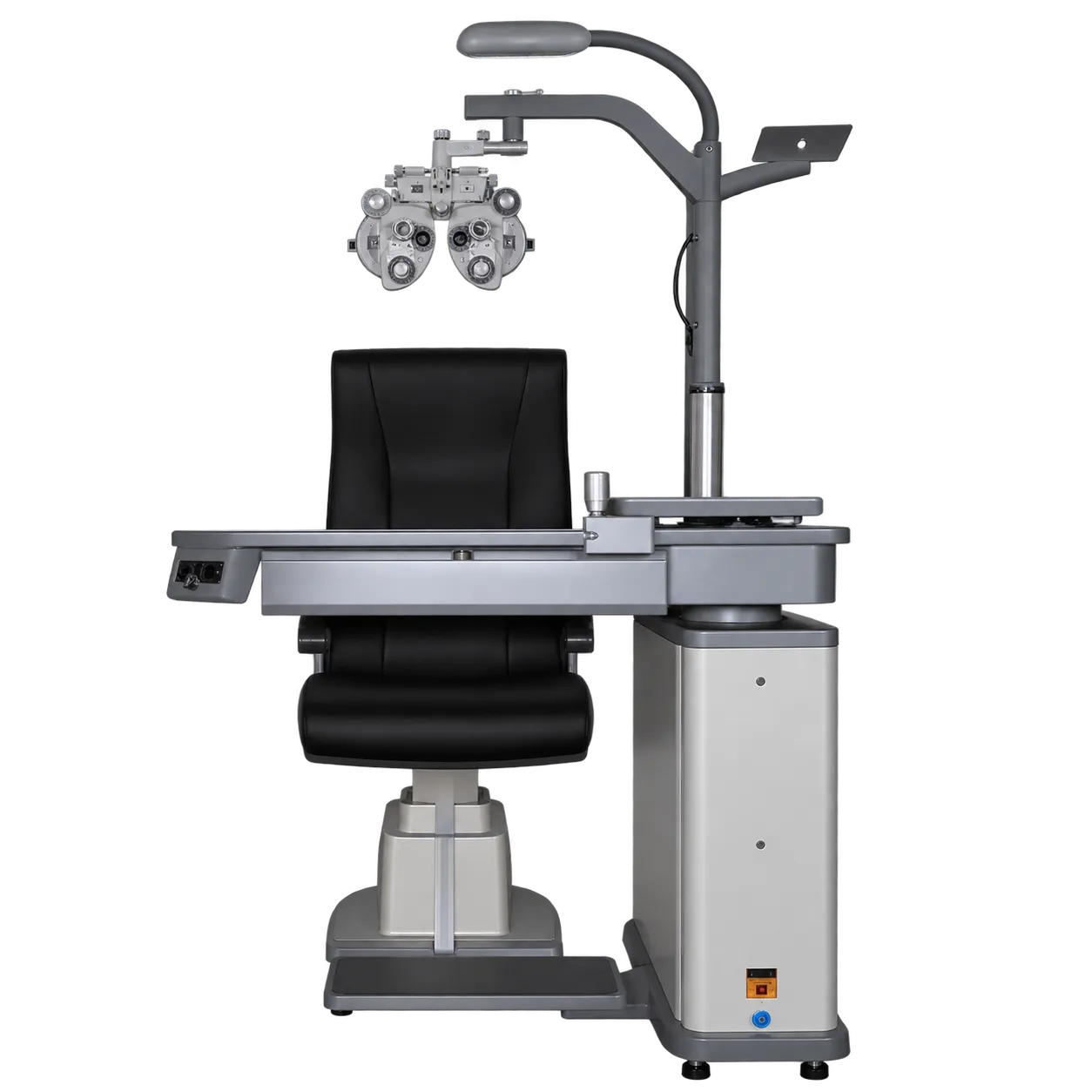
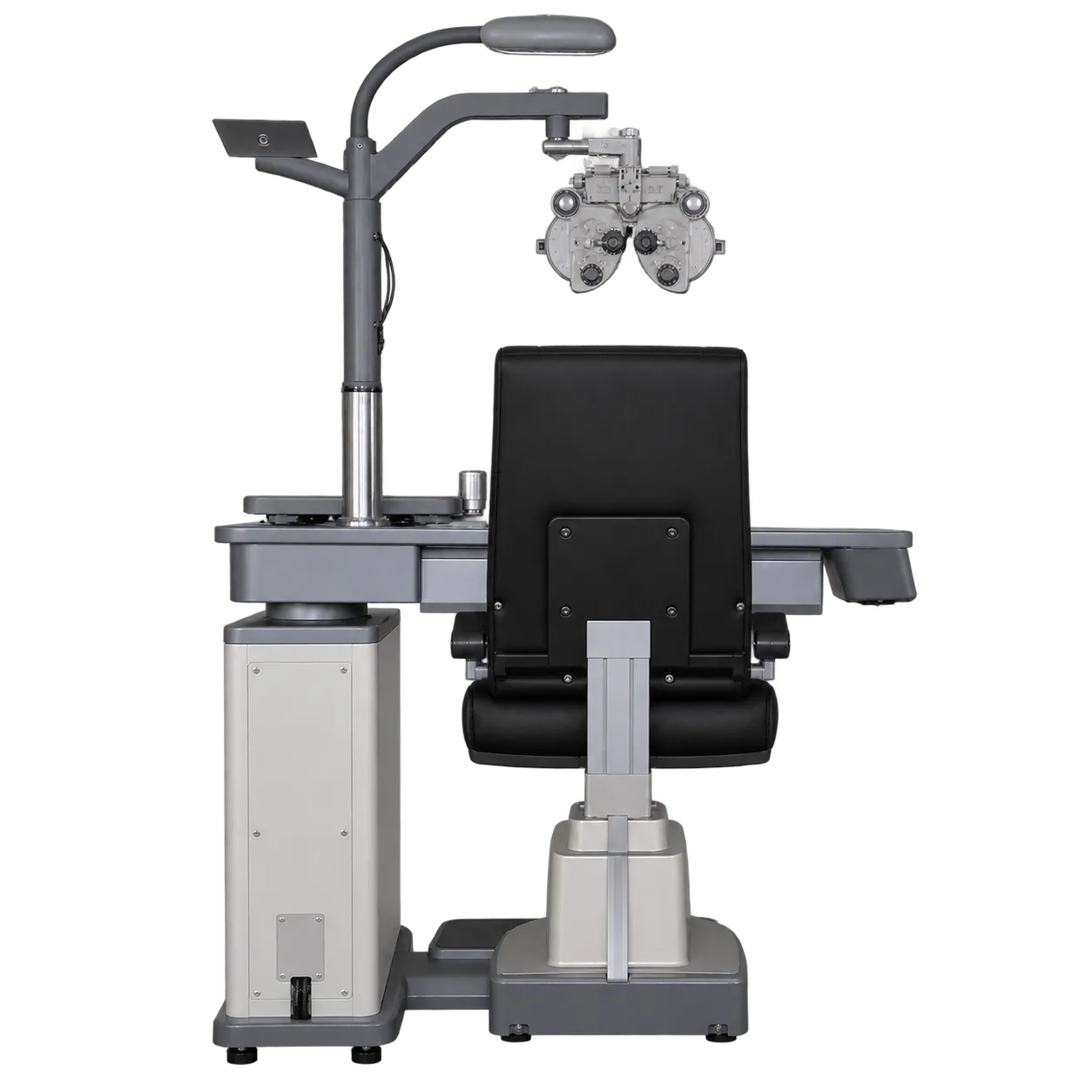
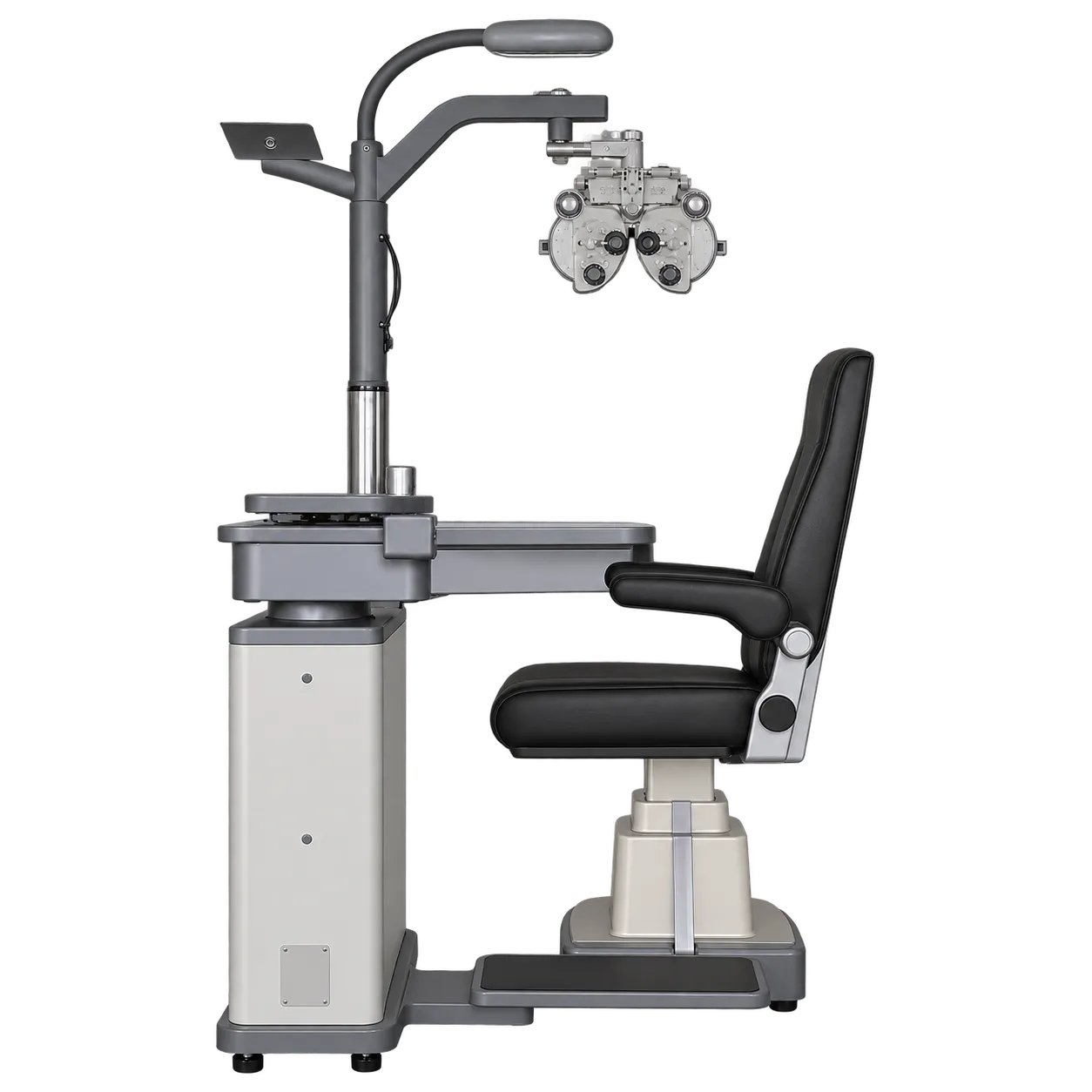
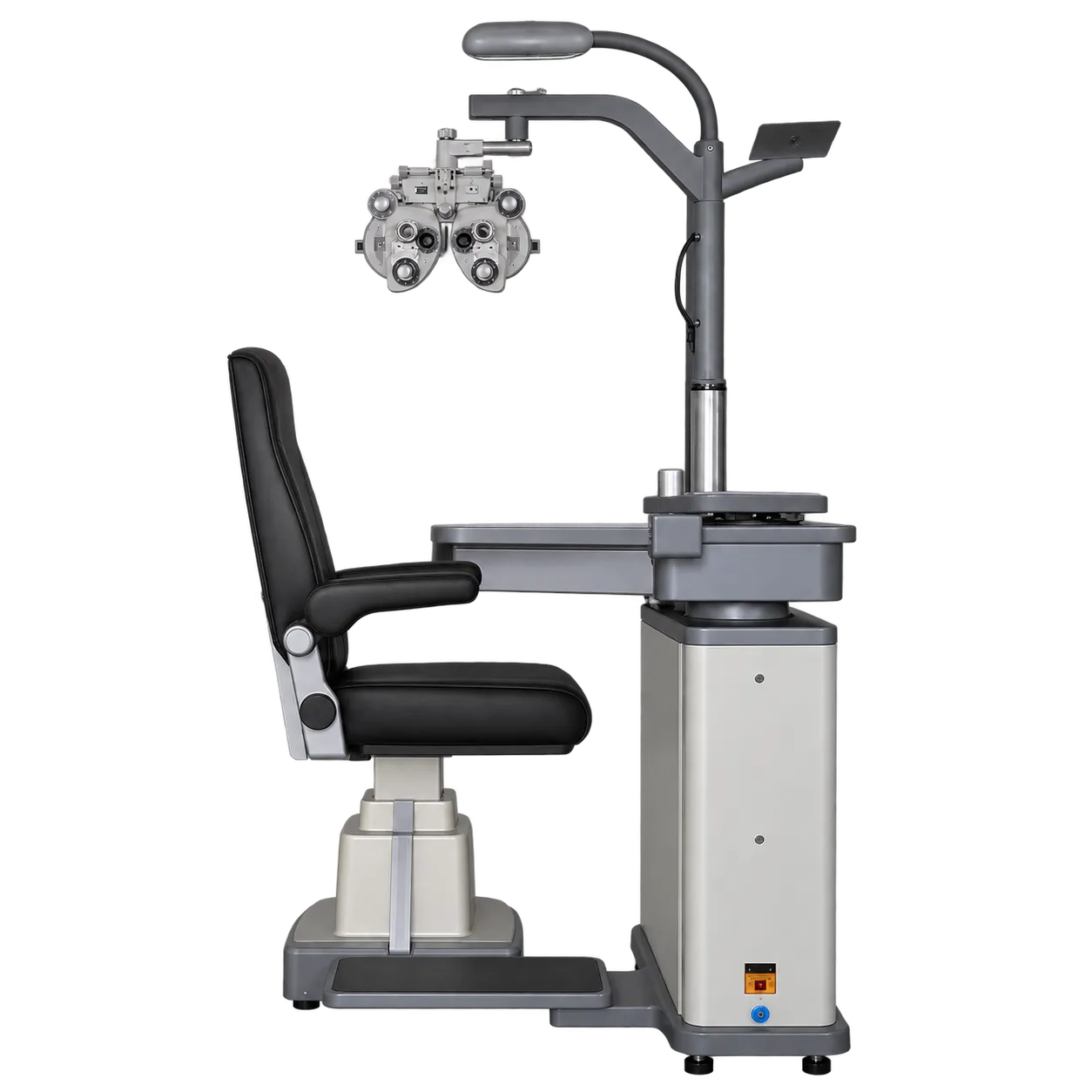
This section is necessarily short, and the reason is the point of the page. Applications follow from specification, and for this model there is almost none: no table size, no arm travel, no chair lift range or loading, no power or voltage. A unit cannot be matched to a room, a caseload or an instrument set from an 1860 × 1030 mm envelope and three photographs.
What the images establish is worth having. A control fascia recessed into the underside of the tabletop edge keeps the controls at the operator's hand without projecting into the strip beside the chair where patients approach and transfer. A curved phoropter arm supports the head over the patient rather than from a vertical beside them, which keeps the forward view clear. A raised retaining lip along the tabletop edge stops a lens case, a pen or a trial frame leaving the surface — a detail datasheets rarely mention and clinicians notice the absence of. Castors appear at the cabinet base.
Those are sensible features and nothing about the visible build suggests the unit is unsuitable. But they are observations from photographs, and observations are not a basis for committing a fit-out budget.
The practical recommendation is therefore procedural. Request the full specification in writing before assessing this model against a room — table and drawer dimensions, tabletop and arm travel, chair lift range and loading, backrest angle, lamp rating, total power, supply voltage and weight. Medigear.uk will do that at enquiry.
Where a decision is needed promptly, the closely related models in this catalogue publish complete dimensional and electrical data, and if their configuration suits they are the more practical starting point.