
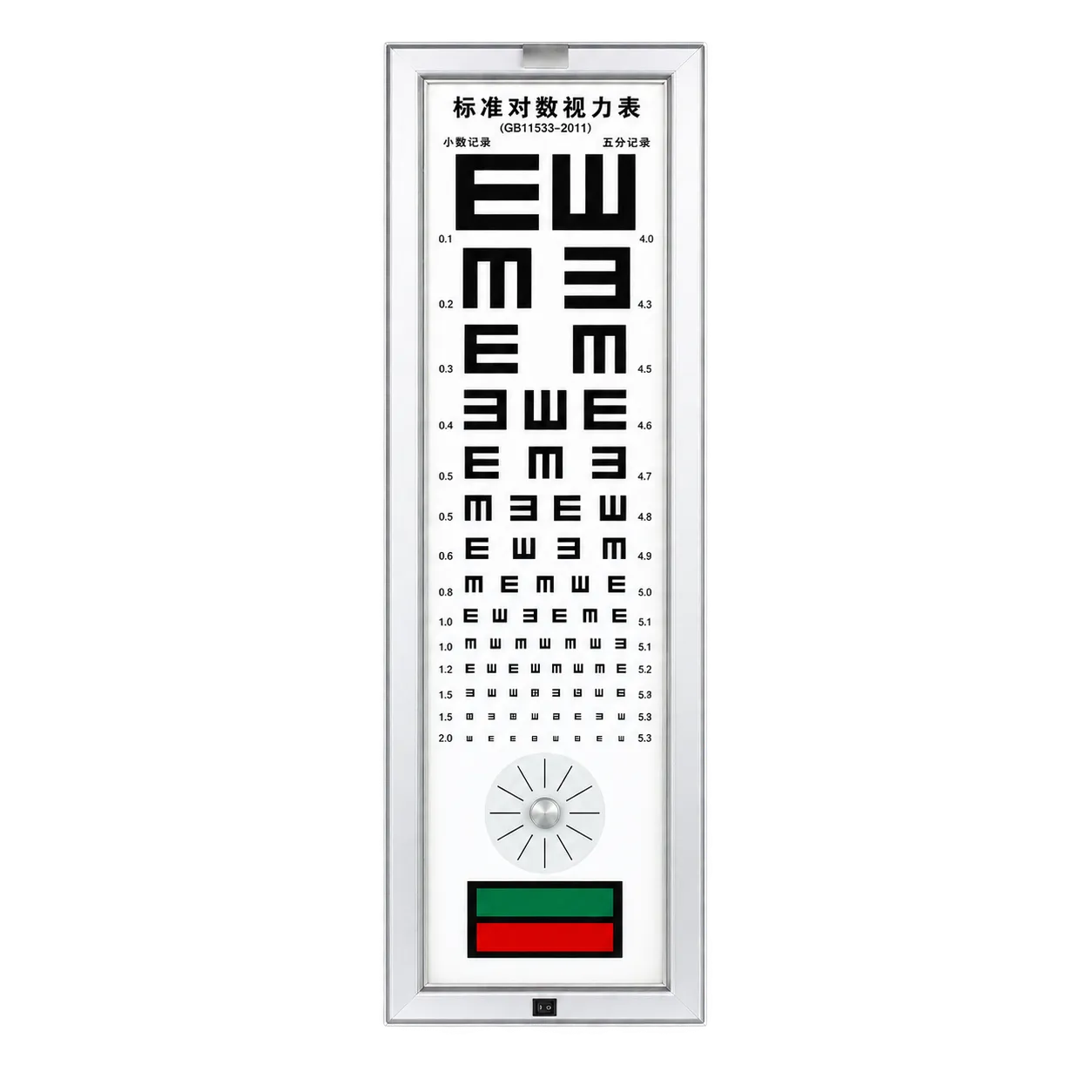
Occupational health and pre-employment screening is the clearest application. These settings run the same acuity test repeatedly, often by staff who are not optometrists, in rooms that serve several purposes. What they need is a chart that works identically every time with no configuration, no login and no possibility of a setting being changed between users. An illuminated chart fixed at 5 metres delivers exactly that, and its lack of flexibility is a feature rather than a limitation in that context.
School medical rooms and community screening services follow the same logic. Vision screening in schools is high-volume, repetitive and delivered by trained non-specialist staff, and equipment that cannot be misconfigured is worth a great deal. The internally lit face also removes the most common source of error in school screening — a printed chart hung in variable daylight, read differently depending on the weather.
General optical practice uses illuminated charts as secondary and corridor positions: a quick check before or after the formal examination, a screening position in a dispensing area, or a backup in a second room. At this cost and simplicity, holding one alongside a digital lane is straightforward.
The 5 metre fixed distance is the defining constraint and should be checked first. The room must provide 5 metres directly or by mirror, and no adjustment is possible. Three further items should be settled before ordering: which national standard the printed face is drawn to and whether it suits UK acuity notation, what acuity range the face covers, and whether alternative or replacement faces are available — because on a fixed-chart instrument the printed face determines the entire clinical scope permanently.