
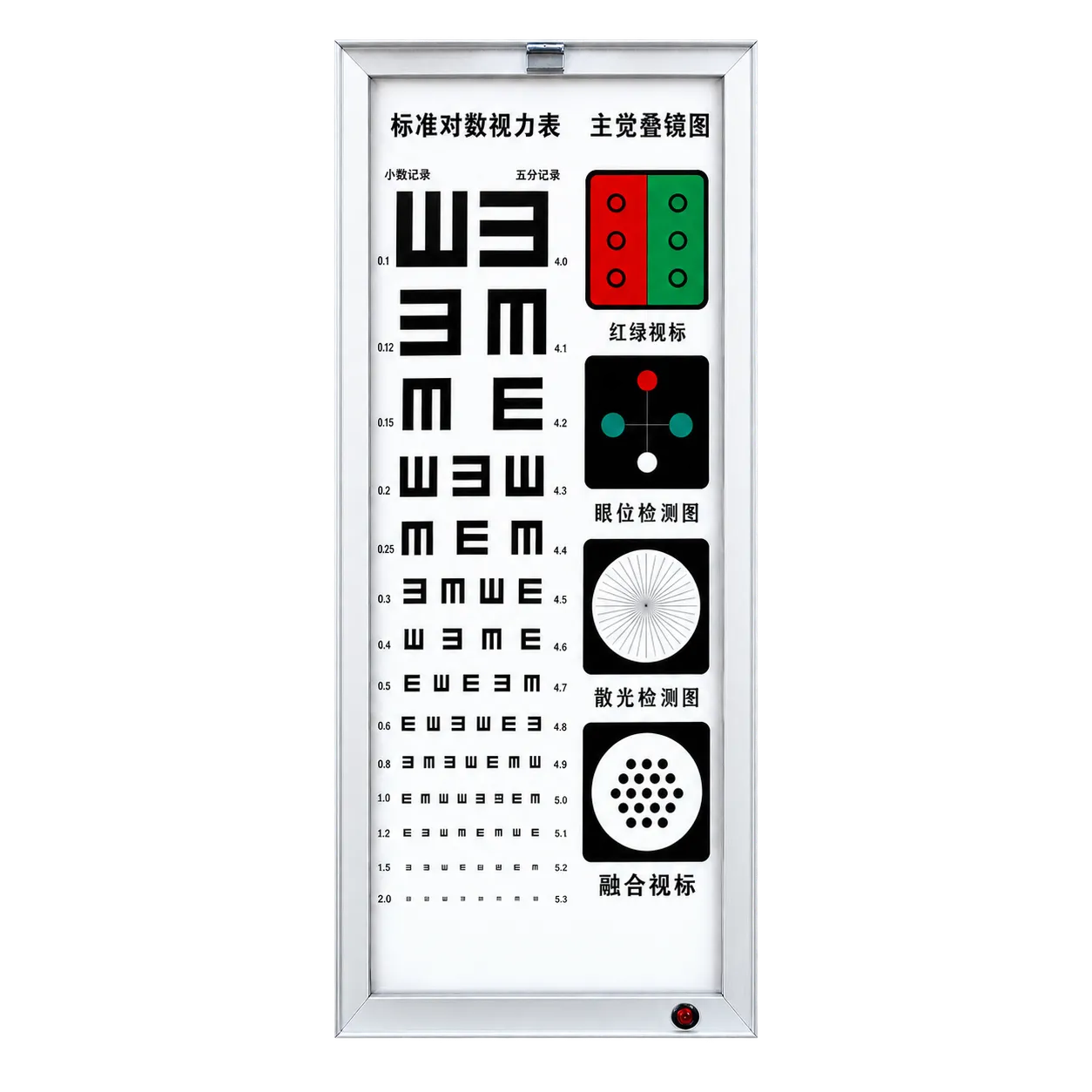
Screening rooms running more than one check are the natural setting. Occupational health assessment, pre-employment screening and school medicals frequently require acuity plus a colour vision check, and sometimes a duochrome or astigmatic look as well. Handled with separate items, each needs its own wall position, its own sight line and its own lighting — and in practice the second check is where a screening session slows down, because it means moving the patient or fetching something. One wide illuminated face presents everything together.
Colour vision screening benefits specifically from backlighting. Colour comparisons are sensitive to both the intensity and the colour temperature of the light falling on the printed surface, and daylight varies in both across a day and a season. A panel lit from behind removes that variable entirely, which makes a screening result taken in December comparable with one taken in June. A printed colour plate on a wall does not offer that.
School medical rooms and community screening services gain from the same consolidation, with the additional advantage that nothing can be misconfigured. Staff delivering high-volume screening are frequently not optometrists, and equipment with no settings to alter removes a whole class of error.
General optical practice uses wide illuminated charts as screening and corridor positions where a quick multi-element check is useful without occupying a full lane. Three things belong in the purchasing decision rather than the small print. The panel complement is not itemised in the supplied literature and is permanent once delivered. The chart standard is stated but not named, and must suit UK acuity notation. And the 5 metre distance is fixed, so the room must provide it before anything else is considered.