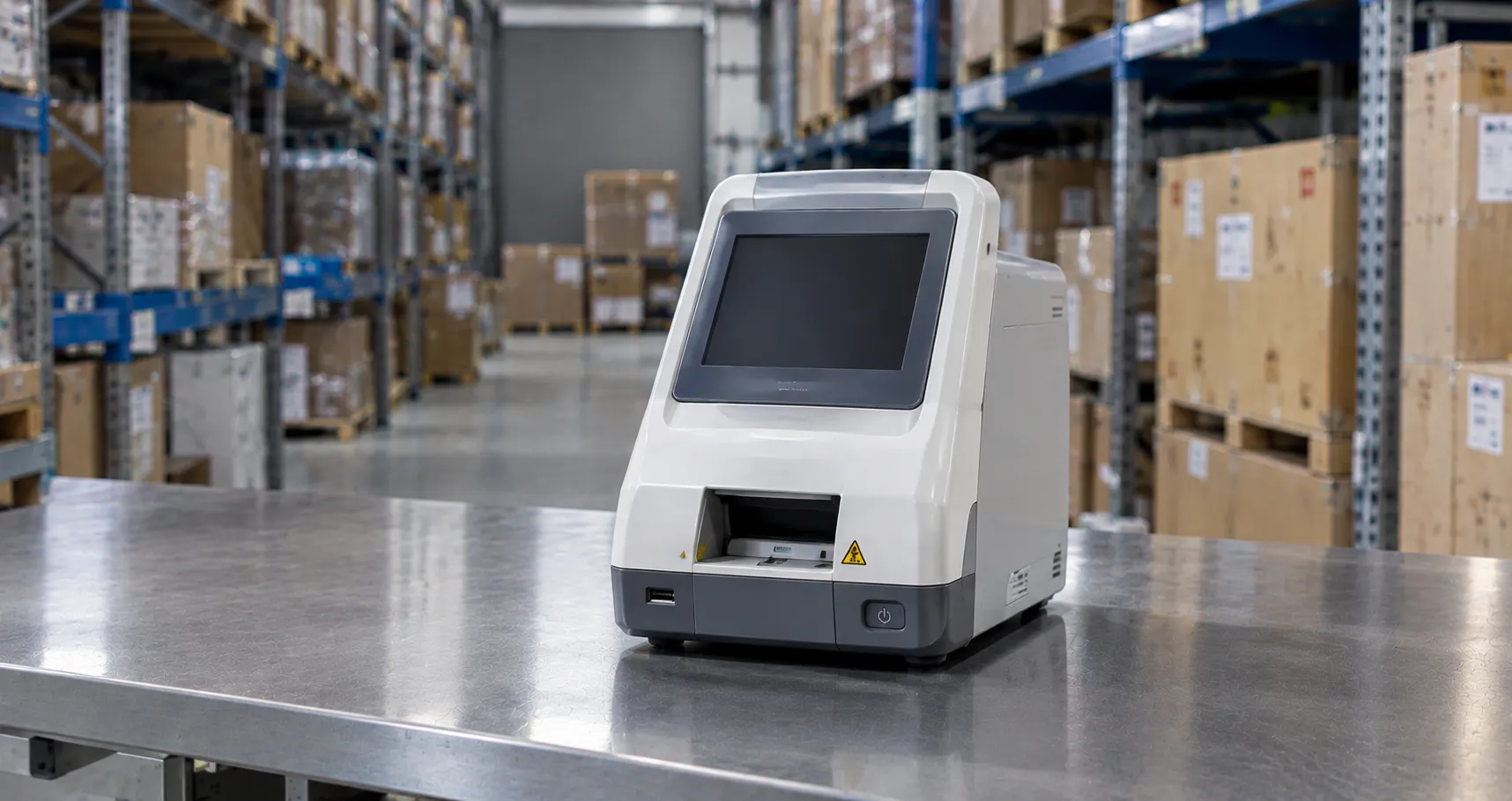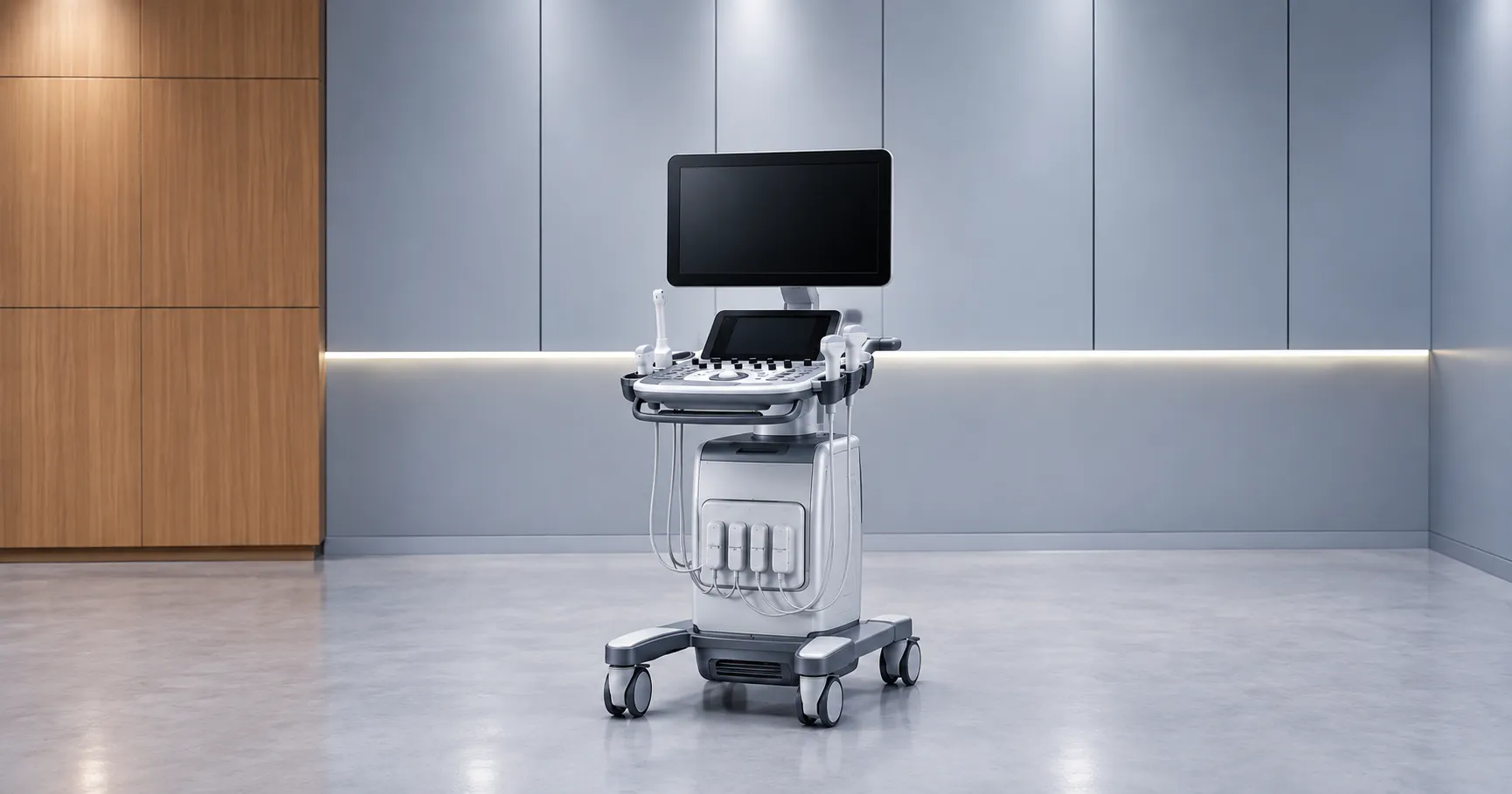

A brain natriuretic peptide analyser measures a hormone the heart secretes when its walls come under stretch, and that reading supports the assessment of suspected heart failure. Assays report either active BNP or the inert fragment NT-proBNP, and both climb as cardiac wall stress rises. For the buyer, the decisions are which of the two markers the platform reports, whether it belongs on the laboratory bench or in a near-patient clinic, how wide and precise its measuring range is, and how the number drives a pathway towards echocardiography and specialist referral.
Natriuretic peptides help include or exclude heart failure alongside examination and imaging. The analyser gives a concentration; the pathway decides who needs a scan and how soon.
Why a stretched heart secretes natriuretic peptides
When pressure or volume overload distends the cardiac chambers, myocytes release a precursor, proBNP, that is cleaved into the active hormone BNP and the inactive NT-proBNP fragment. Both spill into the blood in step with wall stress, so a high level raises the suspicion of heart failure, while a low level makes it unlikely in a patient not already on treatment. Because the peptides mirror how hard the heart is labouring against its load, they triage who should move quickly to echocardiography and cardiology review. Age and impaired kidney function push levels up, obesity pulls them down, and atrial fibrillation can raise them too, so every result is read against the clinical picture rather than in isolation.
BNP or NT-proBNP: choosing the marker
The two analytes share an origin but diverge in behaviour, and a buyer needs to know which the platform reports. BNP is the biologically active hormone with a short half-life of around twenty minutes; NT-proBNP is inactive, considerably more stable in the sample, and circulates at higher numerical concentrations. Their reference thresholds are wholly different and never interchangeable, so any report must name the analyte measured. NT-proBNP clears partly through the kidneys, so renal function sways it more strongly, while sacubitril-valsartan, an angiotensin receptor-neprilysin inhibitor, raises measured BNP because neprilysin normally degrades the active peptide. Neither marker is inherently better; the pick usually follows the assay your analyser offers and the thresholds your pathway is written around, so confirm both before you settle.
The immunoassay behind the number
Natriuretic peptides are measured by sandwich immunoassay. Antibodies specific to BNP or to NT-proBNP capture the target, and a labelled second antibody yields a signal proportional to concentration. Bench analysers detect chemiluminescent or electrochemiluminescent signal as emitted light, giving a broad measuring range and reliable precision. Near-patient analysers hold the chemistry in a single-use cartridge with a fluorescent or comparable readout, returning a result from a small sample within minutes. Because the clinically relevant window stretches from low rule-out figures up to markedly raised values, the assay has to stay accurate across a wide span rather than at one convenient point.
Rule-out thresholds and what shifts them
Heart-failure pathways lean on rule-out thresholds, below which the diagnosis is improbable, and higher action thresholds that trigger urgent referral; the numbers differ between BNP and NT-proBNP and by setting. NICE guidance frames how these levels route patients to echocardiography and specialist assessment within defined timeframes. Confirm the analyser's reportable range spans the thresholds your service uses and that the report states the marker and units without ambiguity. Keep the confounders in mind, since age and renal impairment raise the peptides, obesity lowers them, and atrial fibrillation lifts them, so a single figure is always contextualised. Their real strength is rule-out: a low result in an untreated patient makes heart failure unlikely and can spare an unnecessary echocardiogram, which is why accuracy at the bottom of the range counts as much as at the top.
Bench analyser or near-patient cartridge
The setting shapes the choice of machine. A laboratory immunoassay analyser processes natriuretic peptides in volume at a low unit cost as one assay among dozens, suiting hospitals with dependable sample transport. A cartridge analyser in an emergency department, acute medical unit or community diagnostic centre returns a figure in minutes, speeding triage where waiting on laboratory turnaround would stall the decision. The near-patient route surrenders bulk economy and its sharp per-test pricing for that speed, and it carries the familiar duties of oversight, operator training and quality control. Make sure the near-patient assay reports the same analyte and applies thresholds validated for your use, so a result means the same thing wherever it is produced.
Specifications a heart-failure buyer must weigh
Establish which marker the assay reports, whether the measuring range covers both your rule-out and action thresholds, and the precision as a coefficient of variation across that span. Check sample type and volume, time to result, and either throughput for a bench analyser or cartridge format for a near-patient one. Pay attention to sample stability, including whole-blood and plasma handling, EDTA versus serum requirements, and the permitted time to separation, because pre-analytical mishandling shifts a peptide result. Assess flagging of out-of-range values, interferences and control failures, competency lockout for near-patient operators, and connectivity so results land in the record without transcription.
Regulatory marking and accreditation
A natriuretic peptide analyser is an in-vitro diagnostic that must carry UKCA or CE marking with a declaration of conformity, and its manufacturer must be registered for Great Britain with the MHRA. IEC 61010 covers electrical safety and IEC 61326 electromagnetic compatibility. A central laboratory works to ISO 15189 and a near-patient service to ISO 22870, both with documented operator competency and clinical oversight. Where BNP and NT-proBNP sit in diagnosing and managing heart failure is defined by NICE and local cardiology protocol, with broader medical-device guidance published on GOV.UK. Obtain the conformity paperwork and verify the registration yourself rather than relying on a brochure claim.
Controls, calibration and sample handling
Because the result steers urgent referral and imaging, quality control safeguards the pathway. Analyse two or more control levels, one near a decision threshold, at the maker's intervals and after each reagent-lot change; record the values and act on drift before it reaches a report. Apply traceable calibrators at the stated frequency; cartridge systems read lot calibration from a barcode. Enrol in an external quality assessment scheme for natriuretic peptides so performance is benchmarked. Beyond the instrument, hold pre-analytical discipline, with the correct tube type, prompt separation and storage within the assay's stated stability window, because a mishandled sample can distort the number as surely as an uncalibrated analyser. Keep control and maintenance records for accreditation.
Costing a natriuretic peptide service
Recurring spend decides the business case. A near-patient device uses one cartridge per test plus collection items, whereas a bench analyser draws on bulk reagent, matched calibrators and controls at a unit cost that shrinks with volume. Blood-contacting parts are single-use and go to clinical waste, and the housing is cleaned with an infection-control-approved product. Model the honest cost per reportable result at your expected workload with controls and external quality assessment included, since a low headline cartridge price can mask short dating or cold-chain storage. Ask suppliers about warranty, first-year service, loan cover and the price of common failures. Adding the assay to an immunoassay analyser you already operate is often the cheapest route; the MediGear buyers team can compare the options, or contact us for availability.
Procurement checklist
-
Establish whether the assay reports BNP or NT-proBNP, and that every report names it.
-
Check the measuring range spans your rule-out and action thresholds with good precision.
-
Align the thresholds and units with the heart-failure pathway your service follows.
-
Choose bench or near-patient siting to suit how quickly triage needs the result.
-
Check the UKCA or CE marking, IEC 61010 compliance, and the manufacturer's MHRA registration.
-
Confirm sample stability limits, tube type and time to separation for your workflow.
-
Run a control near a threshold with calibrators and external quality assessment.
-
Cost the reportable result and weigh adding the assay to an existing analyser.
Conclusion
Brain natriuretic peptide analysers deliver a marker that helps triage suspected heart failure, and their value rests on measuring the right analyte accurately across a wide range against the thresholds your pathway sets. Decide between BNP and NT-proBNP by platform and protocol, place testing where the turnaround aids triage most, and protect the result with tight quality control and sound sample handling because it drives referral and imaging. Assessing marker range and thresholds together with MediGear helps your service select a natriuretic peptide platform for dependable heart-failure decisions.
Disclaimer
This article is for informational purposes only. It is published by MediGear (medigear.uk) for general information and procurement guidance, and is not clinical, diagnostic, treatment, technical, engineering, legal or regulatory advice, nor a product endorsement, guarantee or substitute for professional assessment. MediGear does not provide medical consultations. Buyers should consult their clinical, biomedical, estates and regulatory contacts, and the manufacturer's documentation, and independently verify all specifications, certifications, compatibility and suitability before purchase. Specifications, certifications and availability are correct at the time of publication and may change without notice. MediGear is a medical-equipment distributor and does not sell medicines or pharmaceutical products.