
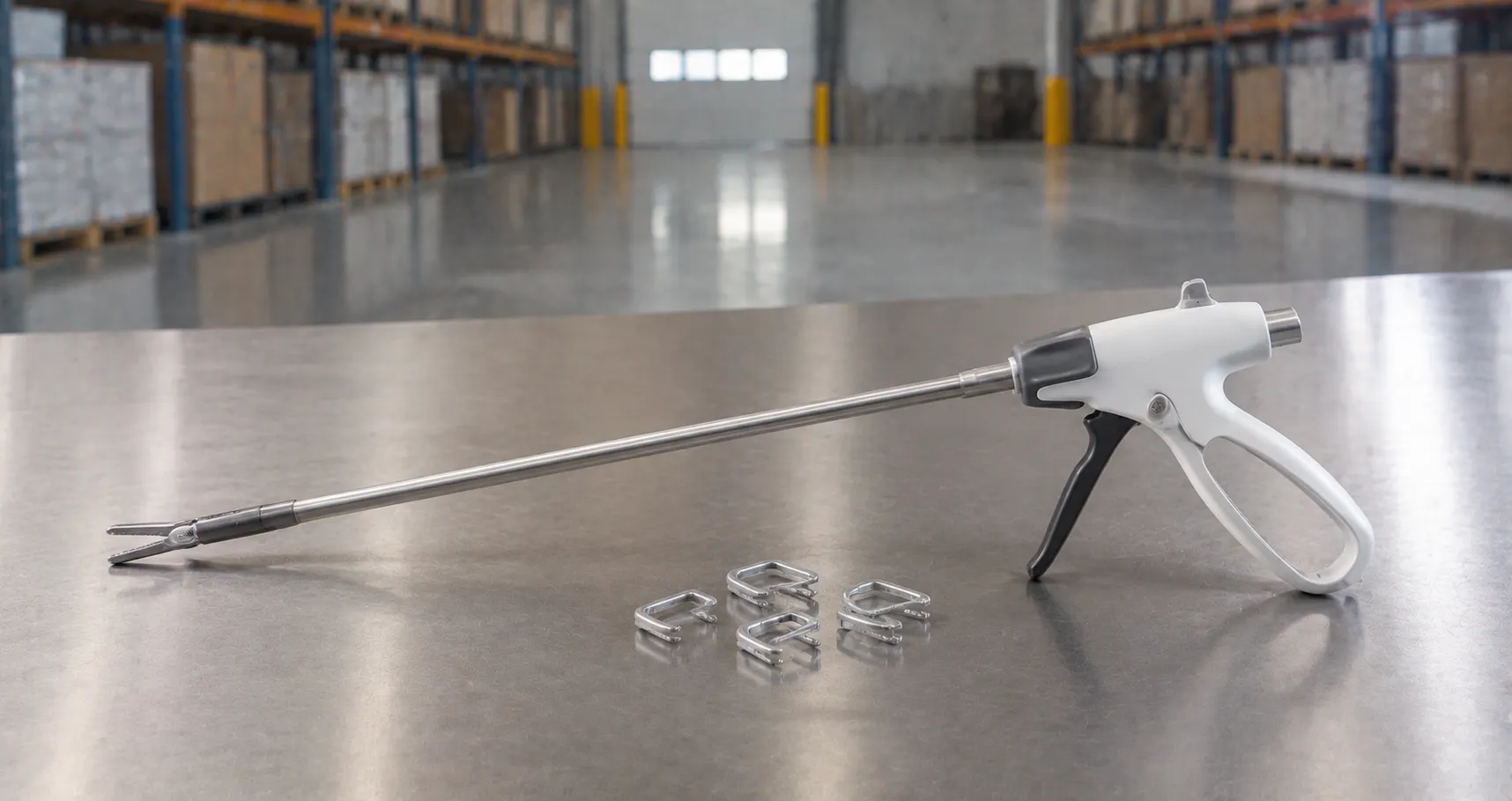
A ligature clip is a small V-shaped or locking fastener that a surgeon closes across a blood vessel, duct, or small tissue pedicle to occlude it, replacing a hand-tied suture ligature. The applicator, or applier, is the instrument that carries the clip to the target and crimps it shut. For a theatre or procurement lead,d the buying decision turns on clip material, the sizing range, whether the applier is single-use or reusable, and how the whole system fits sterile services and stock control.
Clips speed up opening procedures because a vessel can be secured in one movement rather than several to tie and cut a knot. The clip provides the mechanical occlusion; the surgeon's judgement decides which vessels are suitable and when a suture ligature or energy device is the safer choice.
How ligature clips occlude a vessel
Most clips work by compression. The applier jaws hold an open clip, and squeezing the handle bends the legs of the clip together so they flatten the vessel wall between them and stop flow. A metal clip relies purely on that crimp holding its shape, while a polymer locking clip adds a hinge and a latch at the tip so the two legs snap together and resist splaying under pressure or when a vessel is under tension. The occlusion has to survive the pulse pressure of an artery and any traction during the rest of the operation, which is why correct sizing and full closure matter more than speed. A clip that is too small for the vessel may not fully appose the walls, while one that is too large can leave the tips clear of the tissue, so the surgeon confirms that the clip spans the whole vessel and that both legs meet before releasing the applier. Some appliers retain the clip until the handle is fully squeezed to reduce the chance of a partially closed clip being left in place.
Clip materials and the main variants
Two families dominate. Titanium clips are inert, hold their crimp well, and stay in the body permanently; they are widely used and are generally regarded as compatible with later MRI, though buyers should confirm the manufacturer's MRI statement. Polymer locking clips, usually a non-absorbable plastic, give a positive latch that grips larger or more slippery pedicles and produces fewer imaging artefacts than metal. A third group, absorbable clips made from materials such as polydioxanone, is used where a permanent implant is undesirable and the clip is expected to hydrolyse over months. Each type comes in graduated sizes, commonly described as small through to large or extra-large, and each size has its own colour-coded cartridge and matching applier jaw.
Applicator types: single-use, reusable, manual and automatic
Appliers split several ways. A reusable applier is a stainless-steel instrument that is loaded with one clip at a time, cleaned and re-sterilised between cases; it has a low per-case cost but needs the clip cartridge bought separately and adds reprocessing work. A single-use disposable applier arrives sterile and is discarded after one patient, which removes reprocessing and guarantees a sharp, correctly aligned jaw. Automatic multi-fire appliers hold a magazine of clips and advance the next clip after each squeeze, which suits procedures needing many ligations in quick succession. Manual single-clip appliers remain common for open work where deliberate, individually placed clips are preferred. The applier jaw must match both the clip brand and the size, so mixing systems is rarely possible.
Key specifications a buyer must check
Start with the size range and confirm the colour coding matches your surgeons' habits, because a mis-sized clip can slip or fail to close. Check clip material against the clinical need, including MRI compatibility statements where imaging follow-up is likely. For appliers, review jaw length and shaft angle for access in deep open fields, the closing force and feedback, and whether a locking clip gives an audible or tactile confirmation of latch. Confirm magazine capacity on automatic appliers, the reload method, and whether the instrument is rotatable. For reusable appliers, check the number of validated reprocessing cycles and the availability of spare jaws.
Sterility, single-use and reprocessing
Ligature clips are supplied sterile in sealed cartridges and are strictly single-use implants; a dropped or partially closed clip is discarded, never reloaded. Disposable appliers follow the same single-patient rule. Reusable metal appliers are decontaminated through the sterile-services department under the usual washer-disinfector and steam-sterilisation cycles, and their hinges and jaws must be inspected for wear because a worn jaw can deform a clip and cause it to slip. Keep the manufacturer's instructions for use, since the validated cleaning method, lubrication points and the maximum number of cycles are all specified there and underpin your decontamination records.
Use across surgical settings.s
The same clip families appear in general, vascular, urological, gynaecological and thoracic open surgery, and the identical technology scales down to laparoscopic appliers with long shafts. A high-volume general theatre may favour automatic multi-fire disposable appliers for efficiency, while a lower-volume unit or a service that reprocesses instruments may prefer reusable appliers with bought-in cartridges. Day-surgery and independent-sector units often lean toward single-use to simplify sterile-services demand. Whatever the setting, the clinical team, not the buyer, decides which vessels are clip-suitable and where a suture or energy-based seal is required instead.
Standards, regulation and traceability
Ligature clips are implantable medical devices, and appliers are surgical instruments, so both must carry valid UKCA or CE marking with a declaration of conformity, and the supplier must be registered to place them on the Great Britain market. Verify registration through the MHRA, with wider device guidance on GOV.UK. Because clips are implants, batch and lot traceability to the individual patient is essential, so confirm the packaging carries scannable lot data that your theatre system can record. Reusable stainless appliers should meet the relevant instrument-steel and cleanability standards, and the instructions for use must state a validated sterilisation cycle.
Consumables and total cost of ownership
The honest cost sits in the cartridges and disposables, not the headline instrument price. A reusable applier is cheap to own but commits you to a steady spend on clip cartridges plus reprocessing labour and periodic jaw replacement. A single-use automatic applier costs more per case but removes decontamination and always presents a new jaw. Model your genuine cost per case at realistic clip volumes, and include wastage from part-used magazines and dropped clips. Ask each supplier about cartridge shelf life, minimum order quantities, jaw-and-clip compatibility guarantees, and whether trial stock is available so surgeons can confirm handling before you commit. The MediGear buyers team can compare clip-and-applier systems, or contact us for availability and lead times.
Procurement checklist
-
Confirm clip material and MRI-compatibility statements suit your patients and follow-up imaging.
-
Match clip sizes and colour coding to your surgeons' preferences across the full range.
-
Decide reusable versus single-use appliers against your sterile-services capacity.
-
Check applier jaw length, shaft angle and, for locking clips, a positive latch confirmation.
-
Verify UKCA or CE marking, MHRA registration and scannable lot traceability for implants.
-
Confirm reusable-applier reprocessing cycles, spare-jaw supply and inspection routine.
-
Model cost per case including cartridges, wastage and reprocessing labour.
-
Arrange trial stock so handling and closure feedback are checked before purchase.
Conclusion
Ligature clips and their appliers make vessel control in open surgery faster and repeatable, but a sound purchase depends on matching clip material and size to the clinical need, choosing reusable or single-use appliers to fit your reprocessing capacity, and keeping firm implant traceability. Weigh the true cost per case rather than the instrument price alone, and trial the handling before committing. Comparing verified clip-and-applier systems through MediGear helps your theatre buy a haemostasis system that performs reliably and controls stock sensibly.
Disclaimer
This article is for informational purposes only. It is published by MediGear (medigear.uk) for general information and procurement guidance, and is not clinical, diagnostic, treatment, technical, engineering, legal or regulatory advice, nor a product endorsement, guarantee or substitute for professional assessment. MediGear does not provide medical consultations. Buyers should consult their clinical, biomedical, estates and regulatory contacts, and the manufacturer's documentation, and independently verify all specifications, certifications, compatibility and suitability before purchase. Specifications, certifications and availability are correct at the time of publication and may change without notice. MediGear is a medical-equipment distributor and does not sell medicines or pharmaceutical products.