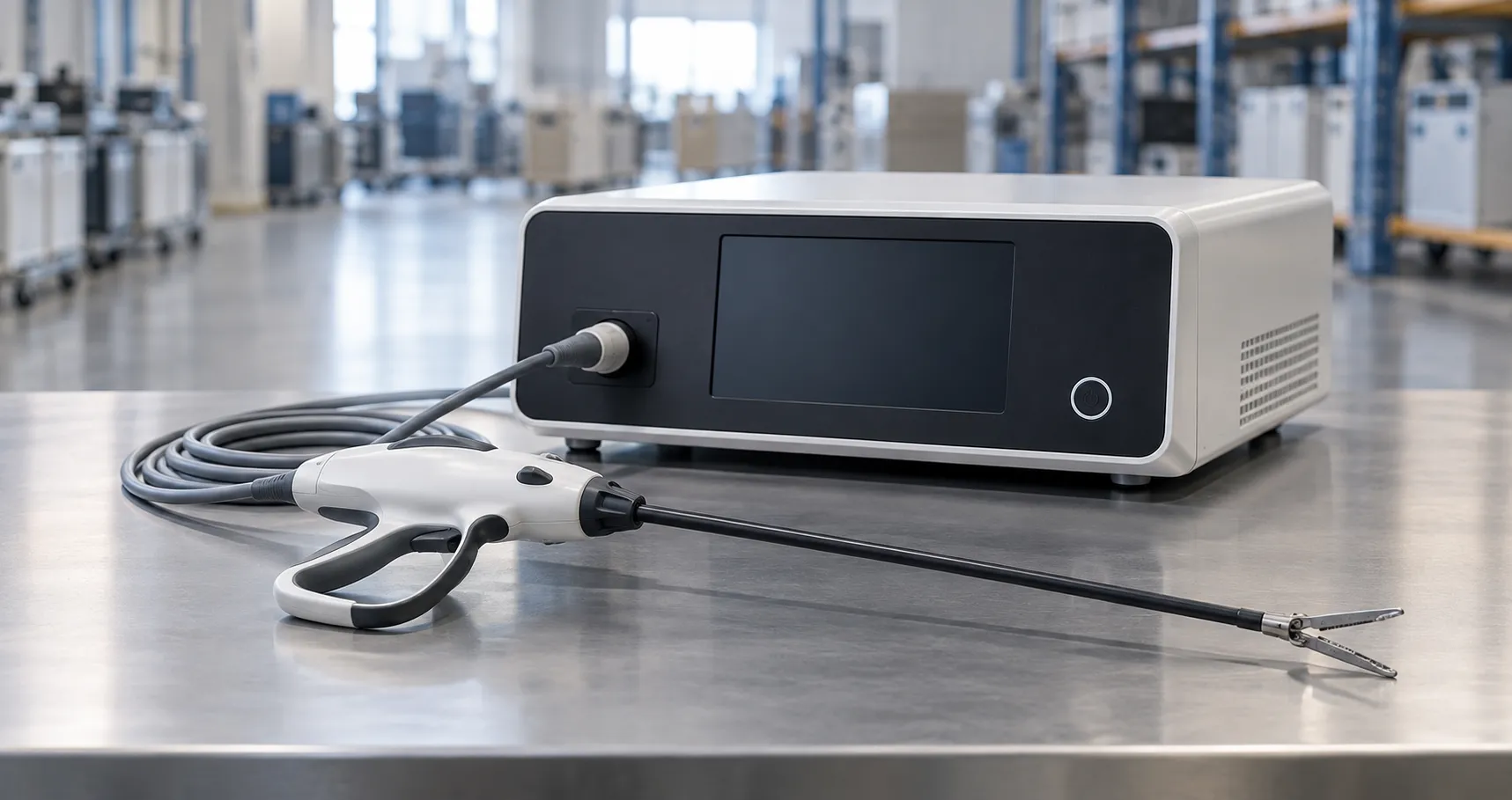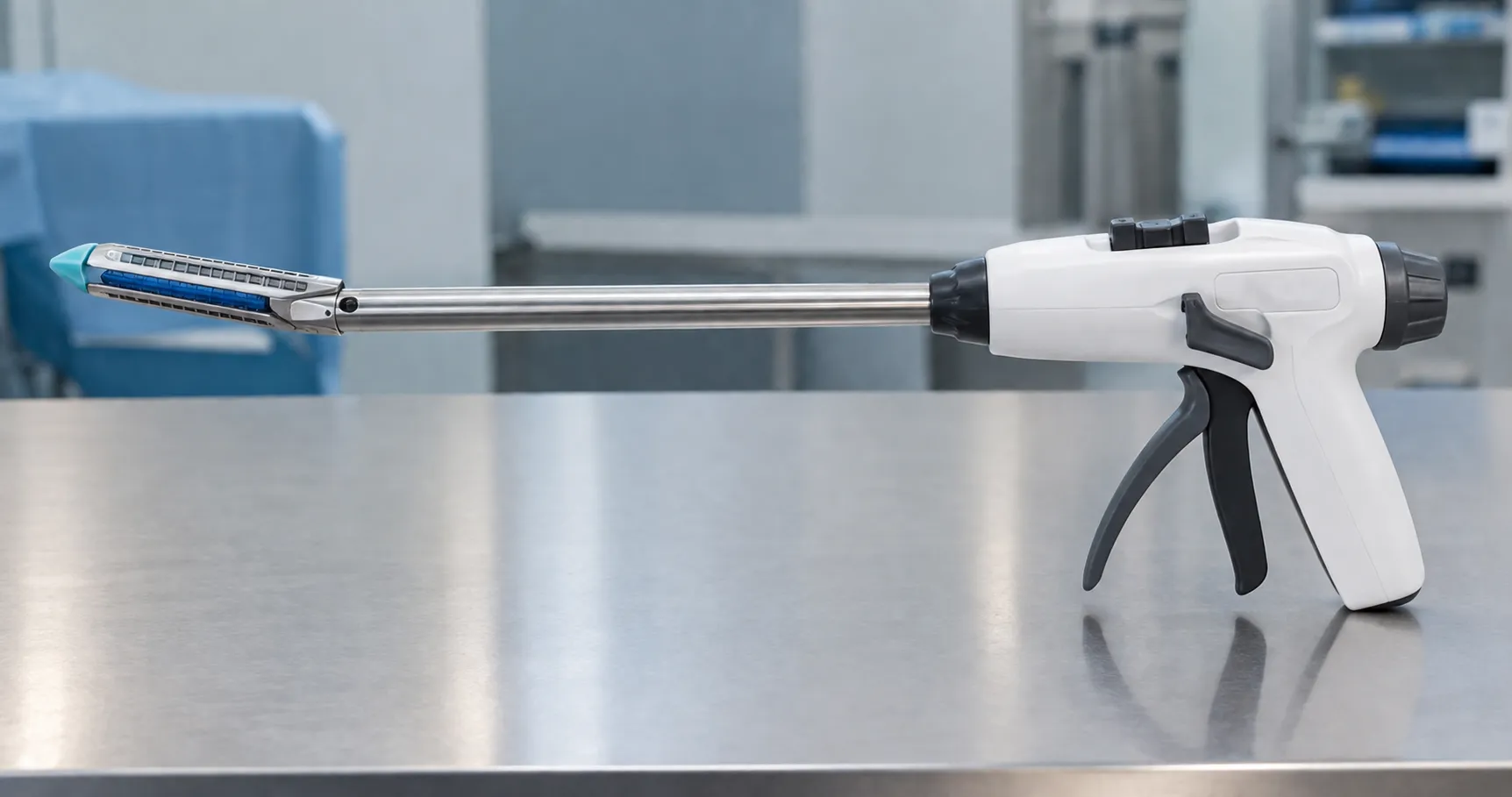
Surgical staplers close and divide tissue by firing rows of small titanium staples, forming them into a B-shape that holds the tissue edges together while allowing blood to keep flowing to the healing line. In gastrointestinal surgery t, they are used to resect and reconnect the bowel, close the stomach, seal the rectal stump, and create anastomoses, doing in seconds what would otherwise be lengthy hand-sewing. They are mechanical devices, not energy devices, so there is no generator, no current,t and no thermal spread — the closure is purely a formed staple line.
For a theatre buyer, staplers are largely a consumable business. Some handles are reusable, but the staple cartridges (reloads) that actually deliver the staples are single-use, and cartridge choice, staple height a, nd cost per fire dominate the purchasing decision far more than the handle itself.
How a surgical stapler works
A stapler holds a cartridge of pre-loaded staples and, in most GI devices, a built-in knife. When the jaws close on tissue and the device is fired, the staples are pushed against an anvil that bends each leg inward into a closed B-shape, and the knife divides the tissue between the staggered staple rows in the same action. The staggered, multi-row layout means the cut edge is sealed on both retained and resected sides. Staple height is the critical variable: the formed staple must be short enough to hold the tissue securely yet tall enough not to crush thick tissue and compromise blood supply, so cartridges are colour-coded by staple height for thin, medium and thick tissue. Choosing the wrong height for the tissue is the classic staple-line error.
The main stapler types in GI surgery
Linear cutter staplers
These place two double- or triple-staggered rows and cut between them, used to divide and seal bowel or stomach. Open and endoscopic (laparoscopic) versions exist, the latter with articulating jaws to reach awkward angles through a port.
Linear non-cutting staplers (TA-type)
These lay a straight staple line without cutting, used to close a stump or reinforce a line. The surgeon divides the tissue separately.
Circular staplers
Circular (EEA-type) staplers create a ring anastomosis, joining two tubular ends, and are central to lower colorectal and oesophageal reconnections. They simultaneously staple a circular line and remove a doughnut of tissue to open the join.
Powered versus manual
Manual staplers are fired by hand grip; powered staplers use a motor to drive firing at a controlled, even rate, which some surgeons prefer for consistent formation in thick or mobile tissue and to reduce the tissue movement that hand-firing can cause. Powered handles add cost and, in some designs, are themselves single-use.
Staple-line reinforcement
Some systems offer a buttress material that is loaded onto the cartridge so it is incorporated into the staple line as it fires, aiming to strengthen the closure and reduce bleeding or leakage in thick or fragile tissue. Reinforcement is an added consumable, so buyers should confirm whether their surgeons use it and that any buttress is validated for the specific cartridge and staple height rather than fitted generically.
Key specifications a buyer must check
Confirm the staple-line length and the staple heights available, and that the colour-coded cartridge range covers the thin-to-thick tissue your GI lists encounter. Check whether the handle is reusable with disposable reloads or fully single-use, and how many times a reusable handle is validated to fire. For laparoscopic devices, confirm shaft length, articulation angle a, nd trocar compatibility. For circular staplers, check the range of head diameters, since the correct diameter must match the lumen. Establish that reloads are the manufacturer's own, because cartridges are proprietary and not interchangeable between systems, and confirm whether staple-line reinforcement materials are offered where your surgeons use them.
Standards, regulation and documentation
A surgical stapler is a medical device and must carry valid UKCA or CE marking, with instructions for use stating the intended purpose, the tissue-thickness range for each cartridge and the single-use status of reloads. Titanium staple material should meet the relevant implant-material standard, since the staples remain in the patient. Because staplers are mechanical, the electrical-safety standards that govern diathermy do not apply, but manufacturing and sterility controls under the medical-device quality framework do, and sterile single-use cartridges carry a sterilisation method and expiry on the pack. Ask the supplier for the declaration of conformity, batch traceability, and confirmation of Great Britain registration. The MHRA is the UK regulator and the route for reporting a misfire or malformed staple line, and device and procurement guidance is published on GOV.UK. Retain lot numbers, because staple-line failures are investigated by batch.
Sterilisation and single-use considerations
Reloads are supplied sterile and are strictly single-use: a fired cartridge is empty and a partially fired one cannot be trusted, so both are discarded. Reusable handles, where offered, are decontaminated and sterilised to the manufacturer's validated method between cases and tracked against their firing limit, after which formation reliability is no longer assured. Fully single-use staplers remove reprocessing entirely but raise the cost per case. Sterile-services teams should confirm the reprocessing route and firing-count traceability for any reusable handle, and stores must manage cartridge shelf life and colour-coded stock so the correct staple height is always to hand during a resection.
Use across settings and total cost of ownership.
GI staplers live in hospital theatres performing colorectal, upper-GI, bariatric and emergency laparotomy work, and analogous devices are used in referral veterinary surgery. Cost is dominated by consumables: a single major resection can use several reloads plus a circular stapler, so annual spend is driven by case volume and the mix of linear and circular devices. Model that against throughput, and standardise cartridge ranges where possible to simplify stock and training while keeping the full height range available. Budget for reusable-handle servicing where relevant, and weigh powered single-use handles against reusable-handle-plus-reload economics for your volumes. Holding the right colour-coded reloads in adequate numbers avoids a case stalling for want of the correct staple height. Our team can help balance handle choice and reload contracts against your GI caseload — register as a buyer or reach us via the contact page.
Procurement checklist
-
Confirm staple-line lengths and the colour-coded staple-height range for thin to thick tissue.
-
Decide reusable handle plus reloads versus fully single-use for your case volume.
-
Check shaft length, articulation, and trocar fit for laparoscopic devices.
-
Verify circular stapler head diameters match your anastomosis needs.
-
Confirm reloads are the manufacturer's proprietary, in-date, sterile cartridges.
-
Request UKCA or CE documentation, staple-material data, and batch traceability.
-
Establish reprocessing route and firing-count limits for reusable handles.
-
Model consumable cost per case from reload and circular-stapler usage.
Conclusion
Surgical staplers make gastrointestinal resection and anastomosis fast and consistent by forming titanium staples into a secure B-shaped line, with staple height matched to tissue thickness as the key clinical variable. Because they are consumable-driven and mechanical rather than energy devices, buying well means focusing on the cartridge range, the reusable-versus-single-use handle decision, proprietary reload compatibility,y and batch traceability. Confirm the UKCA or CE paperwork, staple-material data and sterility before committing. MediGear can help theatres compare stapler systems and reload contracts so GI surgery is supplied reliably and at a sensible cost per case.
Disclaimer
This article is for informational purposes only. It is published by MediGear (medigear.uk) for general information and procurement guidance, and is not clinical, diagnostic, treatment, technical, engineering, legal or regulatory advice, nor a product endorsement, guarantee or substitute for professional assessment. MediGear does not provide medical consultations. Buyers should consult their clinical, biomedical, estates and regulatory contacts, and the manufacturer's documentation, and independently verify all specifications, certifications, compatibility and suitability before purchase. Specifications, certifications and availability are correct at the time of publication and may change without notice. MediGear is a medical-equipment distributor and does not sell medicines or pharmaceutical products.