
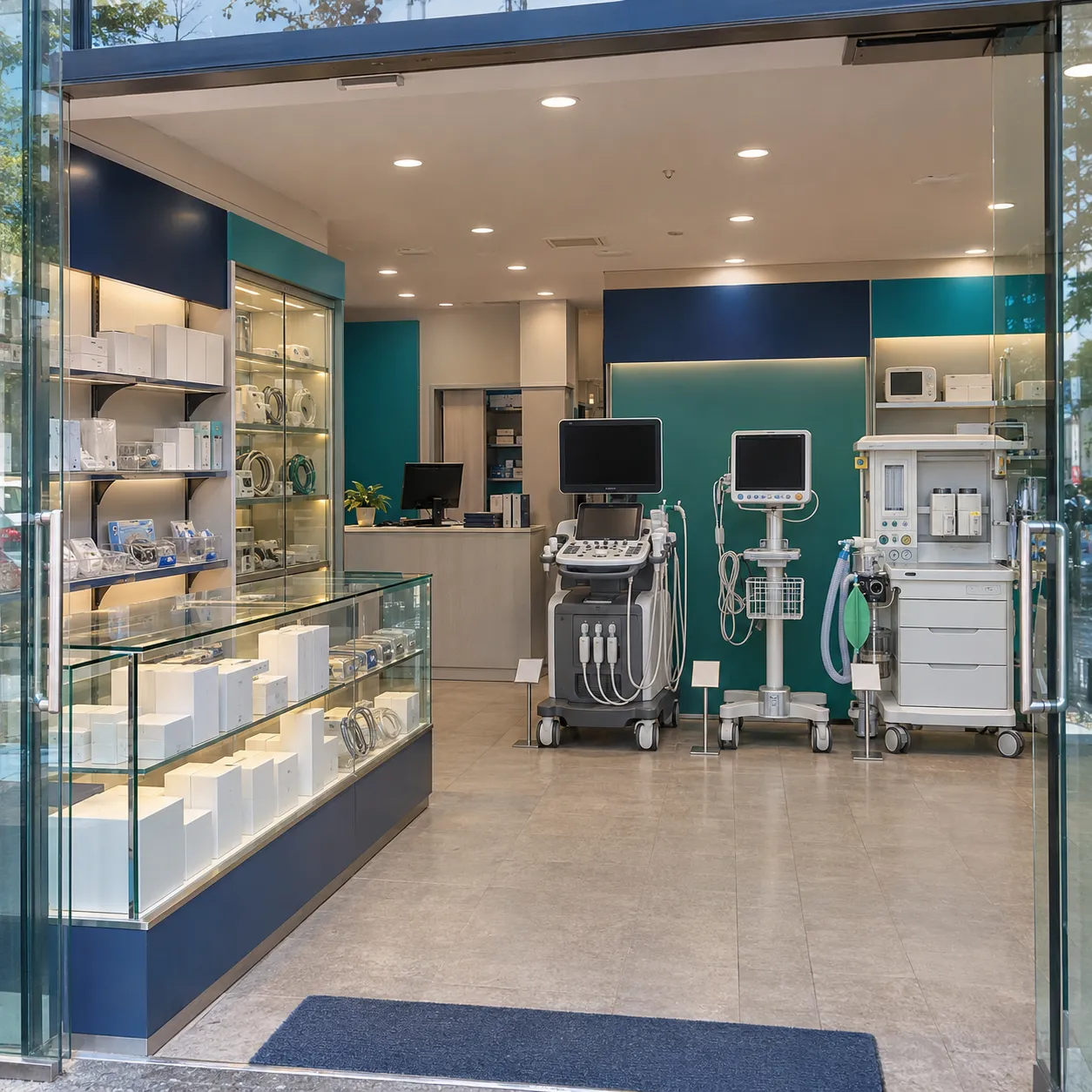
Installed by the maker, tested on site
In Lithuania, a hospital may start using a device only if it meets the EU Medical Devices Regulation. The maker, or an installer it appoints, fits it, and if the maker sets no rules for installers, the hospital may choose one. X-ray units, defibrillators, ventilators and other listed devices are also tested where they will be used, before the first patient. Within 30 days of fitting a powered device, the hospital tells VASPVT, the state body that supervises devices. These rules shape a quote from the first line.
We're MediGear, registered in England and Wales as a medical equipment distributor, and we handle quotes, documents and freight for healthcare buyers in more than 80 countries. For a Lithuanian hospital, we look for verified manufacturers who can supply the model with Lithuanian text and say who will install it. By the time your engineers and buying team see the quote, the points below have been checked. Requests are made on our buyers page, and no account is required.
University hospitals, regional hospitals and clinic networks
Requests are welcome from public and private healthcare buyers such as:
- Santaros klinikos in Vilnius and Kauno klinikos
- Klaipėda University Hospital and other university hospitals
- Republican and regional hospitals across the country
- Private networks such as NORTHWAY and Meliva, and dental clinics
- The National Blood Centre and the ambulance service
- The Military Medical Service
- Distributors, importers and supplies manufacturing companies in Lithuania
Most of these are public bodies. The Ministry of Health oversees Lithuania's healthcare system. It co-owns many of the publicly owned hospitals in Lithuania. Kauno klinikos, the hospital of the Lithuanian University of Health Sciences, reported its first robotic gynaecological operations in October 2026. Public procurement for health in Lithuania follows the Public Procurement Law, and since 1 December 2024, tenders have been run in the new CVP IS system. CPO LT, the national central buyer, runs an e-catalogue that public buyers can use. A private clinic that wants a quote for one MRI system can send us the model.
VASPVT, EUDAMED and Lithuanian texts
The Health System Law sets national device rules for healthcare in Lithuania, alongside the EU regulation. VASPVT, the State Accreditation Service for Health Care Activities, supervises devices on the market and in use. Makers register devices in EUDAMED, the EU database, and Lithuania adds no national registration, though data on devices already on the market is due in EUDAMED by 28 November 2026. Makers, importers and distributors that place class IIa, IIb or III devices on the Lithuanian market also send VASPVT data on a national form.
Instructions for use and upkeep must be in Lithuanian. Texts meant only for healthcare staff may be in English, if the hospital receiving the device agrees, while field safety notices also come in Lithuanian. We are not a Lithuanian importer or distributor and give no regulatory advice, but every quote lists the certificates the unit holds.
RSC licences, registrations and HN 78 tests
The Radiation Protection Centre (RSC) oversees medical X-ray under the Law on Radiation Protection. Only listed low-risk uses, such as intraoral dental units and bone densitometers, are registered; other uses require a licence or a temporary permit. RSC decides within 30 calendar days of a full application, and a licence has no end date. When a unit is added, the holder asks RSC to amend the licence annex within 10 working days, and the changed work starts only once the annex is amended.
Before building work, an X-ray room's design undergoes a safety review, and any change to its plan, use, or unit requires RSC consent. Acceptance tests under the HN 78 norm follow for any new unit, reinstalled unit, or modified unit. After that, most tests on X-ray, fluoroscopy, and CT units are yearly; mammography adds checks every six months, every week, and every day, and dental units are tested every three years.
230 V supply, installers and two-year checks
Before quoting, we settle these with the maker:
- Supply. Sockets accept type C and F plugs, according to the IEC, on a 230 V, 50 Hz supply, so a model sold for 60 Hz markets must be ordered in its European version.
- Installer. The maker or its appointee fits the device and, for X-ray and other listed units, tests it on site and trains staff before first use.
- Two-year checks. Listed devices are checked at the maker's intervals, or at least every two years if the maker sets none, by the maker or holders of a VASPVT certificate. Spare parts and consumables can ship with the unit.
- Exposure control. HN 31 bans X-ray units without automatic exposure control, except for dental, densitometry, and mobile units.
Open points go to the maker in writing before we quote, since a hospital cannot start using a listed device until the maker's side has tested it on site.
iMDAS declarations and State Plant Service checks
Lithuanian customs releases goods on an electronic import declaration, lodged through iMDAS, and arrival data goes in first through ICS2. A representative may lodge it for you. Customs posts also watch devices arriving from outside the EU, and a device that VASPVT finds non-compliant may not be supplied in Lithuania. The order file holds:
- Invoice and packing list for the consignment
- Bill of lading, or an air waybill for flights
- Proof of origin, if the declarant asks
- HS codes against each line
- The CE file and Lithuanian texts
Wood packing must meet ISPM 15. The State Plant Service applies this to wood from all countries outside the EU except Switzerland, with the mark on at least two opposite sides and not in red or orange. Wood from the UK that fails is sent back or destroyed, so we ask makers for heat-treated, stamped crates. Customs' list of permits from other bodies shows none for devices or X-ray equipment.
Klaipėda port and the Vilnius and Kaunas airports
- Hospital and model. Model, quantity, and hospital are confirmed via RFQ form or email, with a note on who will fit the unit.
- Review the quote. Catalogue quotes usually arrive within 48 hours, with certification, lead time, the port and the Lithuanian texts.
- Your written yes. We place the order with the maker once we receive your written approval.
- Klaipėda or the airports. Sea freight into the Port of Klaipėda, or air freight into Vilnius or Kaunas, where cargo airlines are among the main carriers.
We hand the goods over at the port or airport you nominate. There your declarant lodges the import declaration, and the last leg is yours. Shipping or storing an X-ray unit with no radioactive content needs no licence, but fitting, servicing and repairing it in Lithuania does need an RSC licence.
Single scanners, tendered departments and used units
Ordering one ultrasound unit for medical diagnostics in Lithuania is fine, and most catalogue lines allow it. For clinical departments put out to tender in CVP IS, see government tender, and heart teams can browse Cardiology Equipment. A surgical team can name a brain surgery system the same way, and a research group a micro-CT. Our refurbished range covers pre-owned units, and we found no Lithuanian ban on them. For pre-owned units in the Lithuanian healthcare system, the rules are the same as for new devices: EU compliance before first use, fitting by the manufacturer's side and an on-site test for listed units. A reinstalled X-ray unit needs acceptance tests again and a place on the licence annex.
Disclaimer
Read this page as general planning information for Lithuanian buyers, not as an offer to supply or as legal, regulatory or customs advice. Quotes follow the maker's stock and lead times, and no order exists until both sides sign off in writing. Devices require Lithuanian user texts and EU compliance before use, and medical X-ray devices require RSC registration or a licence. Clearance and the regulatory position rest with you and your declarant, since we are not a Lithuanian importer or distributor.
Who will install and test it?
In Lithuania, the maker or an installer it appoints normally fits a device, and X-ray and other listed units are tested on site before first use. Send the model and the hospital, and we'll quote with the CE file, the installer and the route.
Frequently Asked Questions
The quickest route is the RFQ form on the buyer's page, or an email to connect@medigear.uk with the model name or an attached specification. Nobody has to register first. We quote medical equipment and supplies for university and regional hospitals, clinic networks, dental practices, public bodies and Lithuanian distributors. That includes medical and dental diagnostic equipment.
Only in part. Use and maintenance information must be in Lithuanian, but information meant only for healthcare professionals may be in English if the hospital receiving the device agrees. Field safety notices come in Lithuanian, and we check the maker's documents against this before quoting.
Makers register devices in EUDAMED, and Lithuania adds no national registration. Manufacturers, importers and distributors placing class IIa, IIb or III devices on the Lithuanian market send VASPVT data on a national form, and hospitals report newly installed powered devices within 30 days.
An intraoral dental unit, like a bone densitometer, is a listed low-risk use and is registered with RSC. Other uses require a licence or a temporary permit, which RSC decides within 30 calendar days of a complete application; licences have no end date.
The maker or its appointee tests it on site before first use and instructs staff. Acceptance tests under HN 78 follow for any new, reinstalled, or modified unit, with the installer's representative taking part; after that, the licence holder runs periodic tests, most of them yearly.
For sea freight, yes: the Port of Klaipėda is the country's seaport, and smaller items can fly into Vilnius or into Kaunas, where cargo airlines are among the main activities. We deliver to the port or airport you nominate, and your declarant clears the goods from there.
No. One unit is quoted the usual way on most catalogue lines, and if the maker sets a minimum order, our first reply says so. For a listed device, the quote also says who will install it and run the on-site test before first use.
That depends on the maker's stock, the sea leg and the site's own steps, such as RSC's decision within 30 calendar days and the on-site test. Name any deadline in your request, and the quote will state the lead time and route, with email updates once the unit ships.